

In this article (12 sections)
- What is a prop firm passing service?
- Why account sharing and credential sharing matter
- Copy trading and third-party EAs are not one universal rule
- Identity verification, KYC and account review
- IP, device and network rules: what traders should check
- What can happen if a passing service breaks the rules?
- Does “pay after you pass” make a passing service safer?
- How to evaluate a prop firm passing service claim
- Compliant alternatives to outsourcing a challenge
- Worked example: a challenge passes, but the method breaks the rules
- Frequently asked questions
- Key takeaway
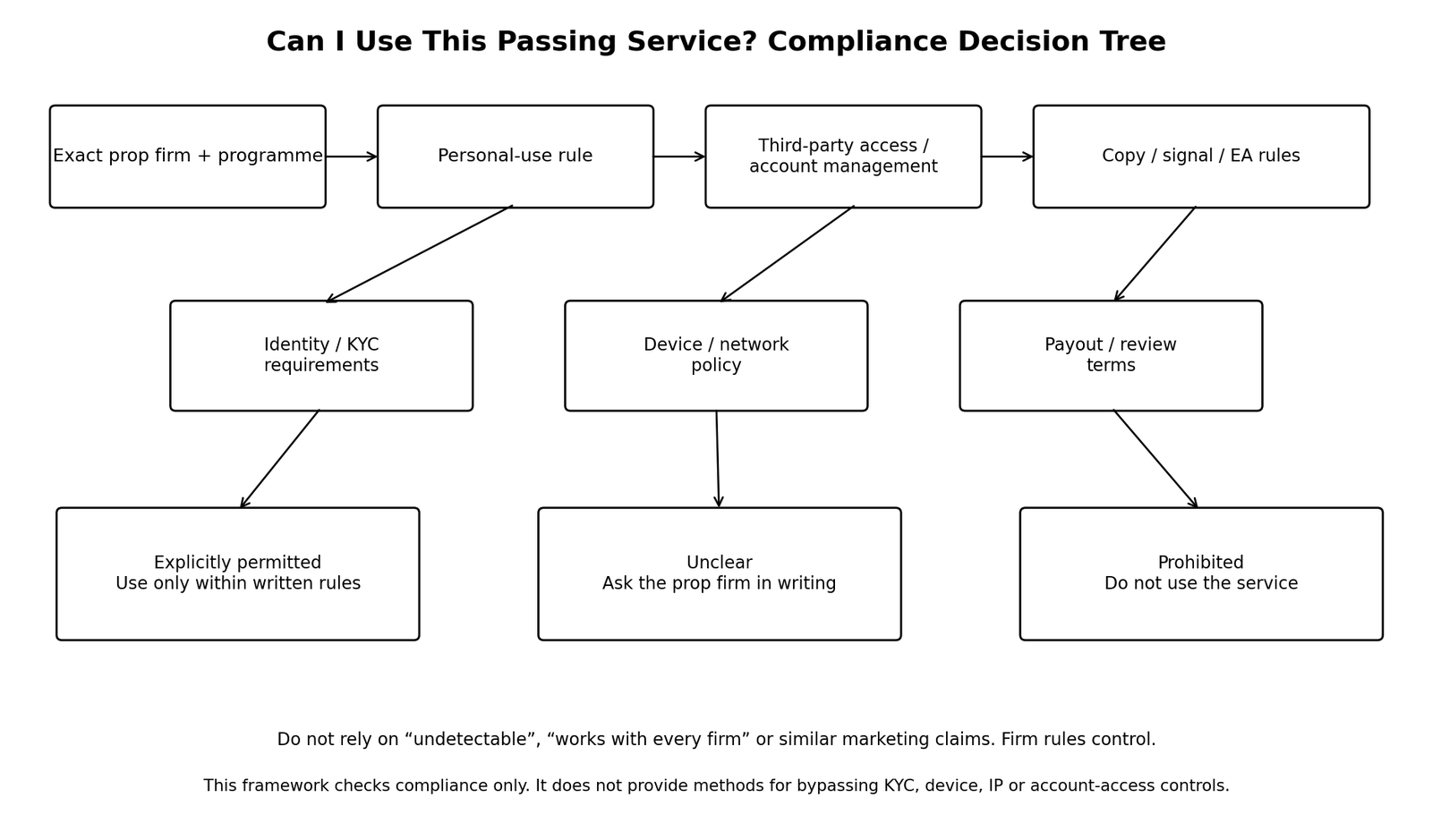
A prop firm passing service is a third party that claims to help or trade for a customer to pass a proprietary trading evaluation. The main risk is contractual: many firms require the registered trader to control and trade the account personally, and some explicitly prohibit account-management or “pass your challenge” services. A challenge can meet its profit target and still fail review if the method breached the programme rules.
What is a prop firm passing service?
Passing services can take several forms. Some offer to trade the evaluation directly. Others provide a copier, signals, a third-party Expert Advisor (EA), or coaching and analytics. Some charge upfront; others use a “pay after pass” model. The label describes the service offer, not whether the method complies with the target firm’s rules.
| Service model | High-level description | Main rule question |
|---|---|---|
| Managed account | A third party logs in or trades the evaluation for the customer. | Does the firm require personal use and prohibit third-party access or trading? |
| Copy / signal service | Trades or signals from another source are mirrored into the account. | Does the firm allow external copy sources, or only copying among the trader’s own accounts? |
| Third-party EA | An external algorithm places trades on the evaluation. | Are outside EAs allowed, and are shared/identical strategies restricted? |
| Pay after pass | The service charges after a target or evaluation outcome is reached. | Does delayed billing change the underlying account-management or copy rule? Usually it does not. |
| Coaching / analytics | The provider supplies education or tools while the trader remains in control. | Does the trader still make the decisions and retain sole account control? |
A passing outcome is therefore not proof of compliance. If the method itself violates the contract, later review can matter more than the numerical profit target.
Why account sharing and credential sharing matter
Prop evaluations are tied to a registered trader or legal entity and the applicable programme agreement. Giving a third party platform credentials or account access can allow someone else to place, modify or manage trades on the registered user’s behalf.
FTMO‘s current personal-use rules prohibit third-party access to an Evaluation/Sim-Funded or FTMO account and prohibit engaging another person to trade for the client. The5ers currently lists account sharing/reselling and account-management “Pass your Challenge” services among prohibited practices. These are firm-specific examples, not a universal rule for every provider.
Credential sharing also creates ordinary security risk: loss of account control, exposure of personal information and disputes over who placed a trade.
Copy trading and third-party EAs are not one universal rule
Copy trading, signals and automation need to be checked separately. Some firms allow copying between accounts owned by the same trader while restricting copying from another trader, a signal source or a shared strategy. The5ers, for example, states that a trader may copy their own trades across accounts, subject to programme conditions, while its prohibited-practices page bans copying/coordinated trading with other traders and “Pass your Challenge” account management.
EA rules can also differ. The5ers permits EAs only within its stated restrictions and requires the trader to own the source code; FTMO warns that a third-party EA can create duplicate strategies across users and may create programme-compliance risk. The correct question is therefore not “Are EAs allowed?” in the abstract, but “Is this exact EA and its source/trading behaviour allowed on this exact programme?”
| Scenario | Possible treatment | What to verify |
|---|---|---|
| Copy your own trades across your own accounts | Allowed by some firms/programmes under limits. | Account ownership, allocation limits and programme-specific conditions. |
| Copy another trader or external signal source | Frequently restricted or prohibited. | Current copy/coordinated-trading rule. |
| Third-party EA used by many customers | May create duplicate activity or breach EA rules. | EA/source-code, strategy uniqueness and automation rules. |
| Another person logs in and trades for you | Often prohibited under personal-use/account-sharing clauses. | Third-party access and account-management terms. |
Identity verification, KYC and account review
Passing the numerical evaluation target may not be the final approval stage. Prop firms can review account activity and require identity verification before issuing the next account stage or approving a reward.
FTMO currently states that FTMO Identity becomes available after the applicable evaluation objectives are met and the results are reviewed. For FTMO Futures, identity verification is completed after passing the Evaluation and before the Sim-Funded Account is issued. This illustrates why a profitable evaluation can still move into a separate compliance and identity stage.
KYC and review are contractual/compliance stages. Do not assume that a service’s claim that it can “pass” a target also means the prop firm will approve progression or payout.
IP, device and network rules: what traders should check
Device and network rules vary materially by provider, so they should be checked from the current policy rather than inferred from forum advice. FundedNext‘s current device and network policy says trading must be conducted from personal devices owned by the trader and prohibits sharing a device with another trader. It also allows different network types, including public internet or VPNs, provided its country-based restrictions are respected.
| Check | Why it matters | Compliant action |
|---|---|---|
| Personal devices | A provider may restrict shared-device access. | Use only devices allowed by the programme. |
| Networks / VPNs | Policies can allow, restrict or condition their use. | Read the current network policy and country restrictions. |
| Travel / changing networks | Legitimate access patterns can still fall under provider-specific rules. | Ask support when the policy is unclear and keep the written answer. |
| Shared IP address | Not a universal proof of wrongdoing. | Do not infer a violation unless the provider’s current policy supports it. |
The compliant approach is verification, not concealment. This article does not provide instructions for masking IPs, spoofing devices, manipulating network identifiers or defeating security reviews.
What can happen if a passing service breaks the rules?
Consequences depend on the exact programme and severity. Current first-party rules show that potential outcomes can include trade removal, disqualification, restricted access, reward forfeiture, account termination or a permanent ban. The5ers states that prohibited-practice violations can lead to termination and that refunds or profit may not be processed. FTMO’s current rules similarly list actions including disqualification, forfeiture of potential rewards and termination. FundedNext also publishes restricted and prohibited strategy rules with stated account consequences.
| Rule issue | Possible consequence | What to check |
|---|---|---|
| Third-party account access | Disqualification, account restriction or termination. | Personal-use/account-management terms. |
| Prohibited copy/coordinated trading | Trade removal, account breach or reward consequences. | Copy-trading and prohibited-practices page. |
| Device/account sharing | Account termination or reward/refund consequences may apply. | Device/network and account-sharing policy. |
| Violation found during payout review | Progression or reward can be denied under programme terms. | Current payout/review clauses and prohibited-practice consequences. |
Because providers use different wording and enforcement rules, use “may” or “can” unless the current programme explicitly states that a consequence is automatic.
Does “pay after you pass” make a passing service safer?
Not in the compliance sense. “Pay after pass” changes when the third party charges the customer. It does not make account sharing, third-party trading, external copying or a prohibited EA compliant with the prop firm’s rules.
| Claim | What it changes | What it does not change |
|---|---|---|
| No fee unless you pass | Reduces or delays upfront payment exposure. | The target firm’s personal-use, copy, EA, KYC or device rules. |
| You only pay after target reached | Defines a billing trigger. | Whether the prop firm approves progression or later reward. |
| Works with many firms | A marketing claim about compatibility. | The exact current terms of the firm/programme you are buying. |
The service contract should define what “pass” means. Reaching a profit target is different from completing review, receiving a funded/sim-funded account, or obtaining a payout.
How to evaluate a prop firm passing service claim
- Identify the exact prop firm, programme and account type before paying any third party.
- Read the current personal-use and account-management terms.
- Check separate rules for third-party copying, signals, EAs and copying among your own accounts.
- Check whether the service asks for platform credentials, remote access, device access or identity information.
- Ask whether the method is explicitly permitted in writing by the prop firm, not merely described as “undetectable” or “works with many firms”.
- Read the passing service’s own refund, dispute, chargeback and data-handling terms.
- If the target firm’s rules are unclear, ask the firm directly and keep the written response.
There is no meaningful “best prop firm passing service” if the method itself violates the target firm’s current rules. Compliance comes before provider marketing.
Compliant alternatives to outsourcing a challenge
If the goal is to improve the chance of completing an evaluation without creating a rule breach, the safer path is to keep account control with the registered trader and use only tools expressly permitted by the programme. For broader context on how these programmes are structured, see our forex prop trading firms guide.
- Use a demo or free-trial environment to learn platform and drawdown mechanics before paying for an evaluation.
- Reduce position size and prioritise rule survival rather than trying to reach the target quickly.
- Write a checklist for daily loss, maximum drawdown, news/holding restrictions and permitted instruments.
- Use education, journaling, calculators or EAs only where the exact programme permits them.
- Ask support for written clarification when copy, device, EA or travel/network rules are ambiguous.
- If you cannot meet the rules consistently without another person controlling the account, delay or skip the evaluation rather than outsourcing account control.
Worked example: a challenge passes, but the method breaks the rules
Hypothetical example only. The scenario is designed to show why numerical success and contractual compliance are separate questions.
| Stage | What happens | Interpretation |
|---|---|---|
| Evaluation | A third party trades a hypothetical $50,000 evaluation and reaches the profit target without breaching the numerical drawdown limits. | The objectives can be met even if the method conflicts with a personal-use rule. |
| Review / KYC | The firm reviews the account under its current terms and verifies the registered trader. | Reaching the target is not necessarily final approval. |
| Rule finding | The programme prohibits third-party account management or account sharing. | The firm may classify the evaluation as non-compliant under the contract. |
| Outcome | Progression, account access or a later reward may be denied or the relationship terminated, depending on the terms. | The main risk came from the method used, not from whether the trades were profitable. |
Actual consequences, review processes and evidence standards differ by firm and programme. This example does not speculate about detection systems or describe any method for concealing access patterns.
Turn Trading Calculations Into Real Trading Decisions
Use your calculated risk levels, position sizing, and technical analysis together with live forex trading signals and market commentary from The Forex Complex.

Frequently asked questions
What is a prop firm passing service?
A prop firm passing service is a third party that claims to help or trade for a customer to pass an evaluation. Models can include managed accounts, copy trading, EAs, signals or coaching. Whether any model is allowed depends on the exact prop firm and programme rules.
Are prop firm passing services allowed?
There is no universal rule, but many firms prohibit third-party account access, account sharing or account-management services. Always check the current terms of the exact programme before using a service.
Can someone else trade my prop firm challenge?
Only if the firm explicitly permits third-party account management. Current FTMO and The5ers rules provide examples of firms that prohibit another person from trading a client’s account or passing a challenge on their behalf.
Is copy trading allowed on prop firm challenges?
Rules vary. Some firms allow copying between accounts owned by the same trader under stated limits while prohibiting copying from another trader or external signal source.
Can using a passing service affect my payout?
Yes. If the method breaks the programme rules, the firm may refuse progression or a reward, cancel the account or terminate the relationship, depending on its current terms.
Does pay-after-pass remove the risk?
No. It changes when the service charges you, but it does not make account sharing, third-party trading, a prohibited copier or a restricted EA compliant with the target firm’s rules.
Key takeaway
A passing service should be evaluated as a compliance question before it is evaluated as a performance service. Managed access, external copying, third-party EAs and coaching are different behaviours and can be treated differently by prop firms. The safest evidence is the current first-party rule text for the exact programme, plus written clarification when the rule is ambiguous. A profitable challenge result does not override a contractual breach.




 Join Our Free Group

 Twitter