

In this article (12 sections)
- What is the US dollar index (DXY / USDX)?
- Which currencies are in the DXY basket?
- How is the US dollar index calculated?
- What does a rising or falling DXY mean?
- Why DXY and EUR/USD often move in opposite directions
- How Federal Reserve expectations and US yields can influence DXY
- How to use DXY alongside major USD pairs
- How to read a DXY dollar chart
- DXY vs the Federal Reserve broad dollar index
- Worked example: broad USD strength, different pair magnitudes
- Limitations of using DXY in forex analysis
- Frequently asked questions
The US Dollar Index, usually called DXY and formally represented by ICE as USDX, measures the US dollar against a fixed basket of six currencies. Because the euro carries 57.6% of the basket, DXY is heavily influenced by EUR/USD. Forex traders can use it as broad USD context, but it is not a standalone signal for every dollar pair.
What is the US dollar index (DXY / USDX)?
The ICE U.S. Dollar Index is a benchmark that combines six exchange rates into one index level. ICE uses USDX in its formal rules and contract naming, while DXY is the common market shorthand used on many charts and in commentary. The benchmark is designed to show the dollar’s weighted value against its specified basket, not against every major currency or every US trading partner.
DXY vs USDX: They refer to the same underlying ICE U.S. Dollar Index benchmark. “DXY” is the common market/chart name; “USDX” is the formal ICE abbreviation used in index and futures documentation.
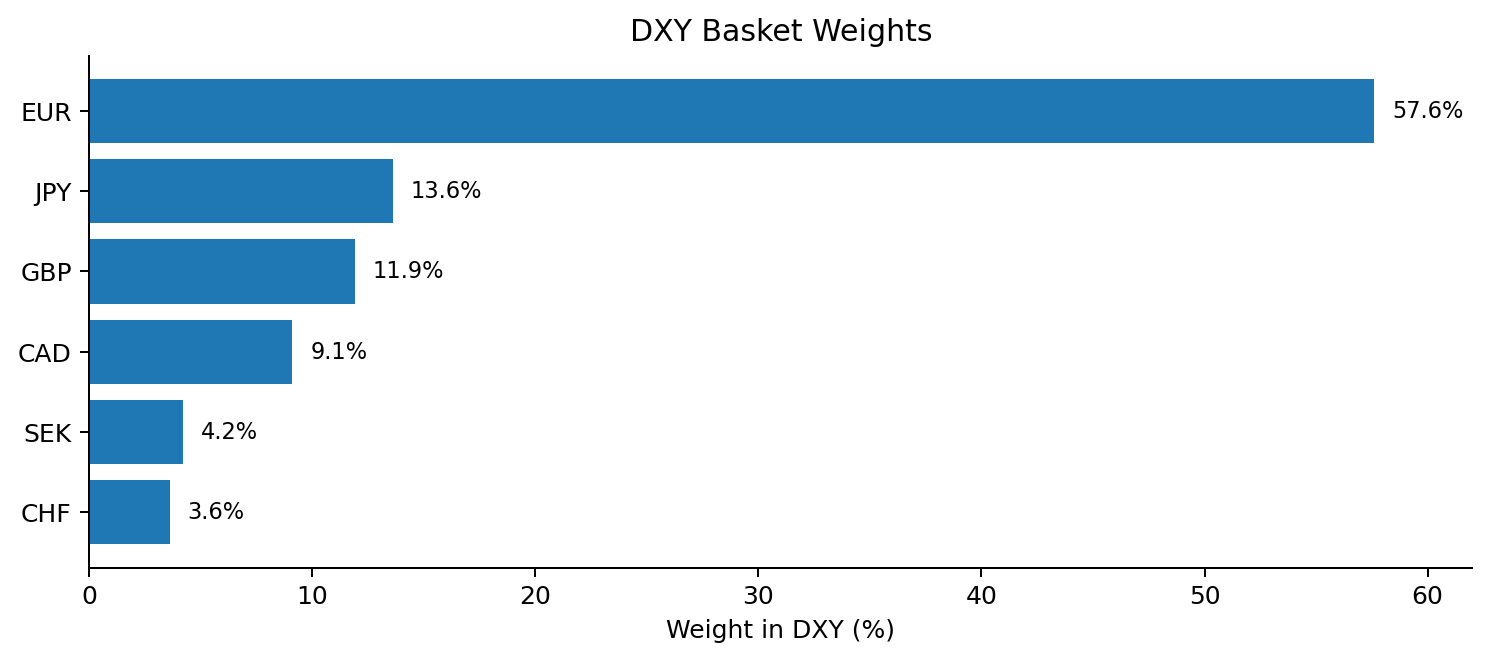
Which currencies are in the DXY basket?
| Currency | ISO | Weight | Common USD pair |
|---|---|---|---|
| Euro | EUR | 57.6% | EUR/USD |
| Japanese yen | JPY | 13.6% | USD/JPY |
| British pound | GBP | 11.9% | GBP/USD |
| Canadian dollar | CAD | 9.1% | USD/CAD |
| Swedish krona | SEK | 4.2% | USD/SEK |
| Swiss franc | CHF | 3.6% | USD/CHF |
The euro alone represents more than half of the basket. That concentration is why EUR/USD often has an outsized influence on DXY. The basket also excludes currencies such as CNY, MXN and AUD, so DXY should not be described as a comprehensive modern trade-weighted measure of the dollar against the global economy.
How is the US dollar index calculated?
ICE calculates DXY as a geometrically weighted combination of the six component exchange rates. The current ICE FX Indices methodology uses the constant 50.14348112 and the fixed component weights shown above. The sign of each exponent depends on quote convention: EUR/USD and GBP/USD are quoted as US dollars per foreign currency, while pairs such as USD/JPY are quoted with USD as the base currency.
Formula context: The published DXY number is an index level, not an exchange rate. The formula aggregates several spot exchange rates into a relative benchmark, so a DXY value such as 100 or 105 should not be interpreted as a “price of the dollar”.
What does a rising or falling DXY mean?
| DXY move | What it means | What it does not mean |
|---|---|---|
| Rising | USD is strengthening against the weighted basket overall. | Every USD pair must rise or every basket currency must weaken by the same amount. |
| Falling | USD is weakening against the weighted basket overall. | Every USD pair must fall or EUR/USD must rise one-for-one with DXY. |
Because the basket is fixed and euro-heavy, a large EUR move can dominate the index even when other components behave differently. Treat DXY direction as context for broad-dollar conditions, then analyse the pair-specific counter-currency before drawing a trading conclusion.
Why DXY and EUR/USD often move in opposite directions
EUR accounts for 57.6% of DXY and EUR/USD is quoted as dollars per euro. When EUR/USD falls because the dollar strengthens against the euro, that move commonly contributes upward pressure to DXY. The relationship is structurally strong, but not perfectly one-for-one because the other five currencies also move and the index is geometrically weighted.
Avoid pseudo-precision: A single universal DXY/EUR/USD correlation coefficient is not appropriate. Any correlation number depends on the selected sample period, frequency and market regime.
How Federal Reserve expectations and US yields can influence DXY
| Driver | Transmission channel | Possible DXY response | Why it may differ |
|---|---|---|---|
| Fed policy expectations | Changes the relative expected return on USD assets. | More hawkish relative repricing can support USD. | Other central banks may reprice at the same time. |
| US Treasury yields | Can reflect inflation, growth and policy expectations. | Higher relative yields can support USD demand. | Yield moves may reflect risk or growth concerns rather than policy alone. |
| US macro data | Can change the expected Fed path and growth outlook. | Positive USD repricing may lift DXY. | The surprise may be priced in or offset by revisions/positioning. |
| Risk sentiment | Can change demand for USD liquidity and defensive assets. | Some risk-off episodes support DXY. | JPY/CHF moves, falling US yields or event-specific positioning can offset it. |
FX is a relative market. The relevant question is often not whether US yields rose in isolation, but whether US rate expectations changed relative to the ECB, BoJ, BoE, BoC, Riksbank and SNB outlooks.
How to use DXY alongside major USD pairs
| Pair | USD position | Typical relationship to DXY | Main caveat |
|---|---|---|---|
| EUR/USD | Quote | Often inverse | EUR has the largest DXY weight, but euro-specific news can dominate. |
| GBP/USD | Quote | Often inverse | BoE and UK data can create pair-specific moves. |
| USD/JPY | Base | Often same direction | BoJ policy, yields and risk sentiment can dominate JPY. |
| USD/CAD | Base | Often same direction | Oil, Canadian data and BoC expectations can dominate CAD. |
- Compare the DXY trend with the pair trend on the same approximate time horizon.
- Check whether USD is the base or quote currency in the pair.
- Identify the counter-currency catalyst: central bank, data, commodity exposure or risk sentiment.
- If DXY and the pair diverge, investigate the counter-currency rather than assuming one chart is wrong.
- Use DXY as confirmation/context, not as an entry, stop or position-size rule.
How to read a DXY dollar chart
A DXY chart can be read with the same neutral price concepts used elsewhere: trend, swing highs and lows, support and resistance, range, breakout and failed breakout. The levels are index levels, not executable prices for EUR/USD, USD/JPY or another spot pair. Any live DXY chart should show its data source, timestamp and delay status.
DXY vs the Federal Reserve broad dollar index
| Feature | DXY / USDX | Federal Reserve Broad Dollar Index |
|---|---|---|
| Construction | Six fixed currencies with fixed weights. | Weighted average against a broad group of major US trading-partner currencies. |
| Euro concentration | EUR = 57.6%. | Broader currency coverage; not centred on the same six fixed weights. |
| Purpose | Market benchmark for the fixed ICE basket. | Broader trade-weighted measure of the foreign-exchange value of USD. |
| Interchangeable? | No. | No – similar direction at times does not make the methodologies equivalent. |
The Federal Reserve currently publishes Broad, Advanced Foreign Economies (AFE) and Emerging Market Economies (EME) dollar indexes under H.10. These are separate measures from ICE DXY and should not be described as the same index.
Worked example: broad USD strength, different pair magnitudes
| Observation | Illustrative value |
|---|---|
| DXY | 102.00 -> 103.02 (+1.0%) |
| EUR/USD | 1.0900 -> 1.0824 (-0.7%) |
| USD/JPY | 147.00 -> 147.74 (+0.5%) |
| GBP/USD | 1.2700 -> 1.2649 (-0.4%) |
DXY rises by 1.02 points, equal to 1.0%. EUR/USD and GBP/USD fall while USD/JPY rises, which is broadly consistent with USD strength. The moves are not identical because each counter-currency has separate drivers and the DXY basket itself is unevenly weighted.
Interpretation: Use the DXY rise as evidence that USD strength is relatively broad across the six-currency basket, then investigate why each pair moved by a different amount. The example is illustrative, not a stable correlation rule or trade recommendation.
Limitations of using DXY in forex analysis
- The euro-heavy basket can dominate short-term DXY movement.
- The fixed basket excludes many important currencies and trading partners.
- DXY cannot capture every pair-specific central-bank, commodity or macro driver.
- Pair correlations change across timeframes and market regimes.
- DXY does not provide an entry price, stop-loss level, position size or profit target.
- Any DXY-based strategy still needs realistic spread, slippage and execution assumptions.
Turn Trading Calculations Into Real Trading Decisions
Use your calculated risk levels, position sizing, and technical analysis together with live forex trading signals and market commentary from The Forex Complex.

Frequently asked questions
What is DXY in forex?
DXY is ICE’s US Dollar Index, a benchmark measuring USD against a fixed basket of six currencies. Traders use it as broad-dollar context, not as a standalone trade signal.
What is the difference between DXY and USDX?
They refer to the same ICE U.S. Dollar Index benchmark. USDX is the formal ICE abbreviation used in rules and futures documentation, while DXY is the widely used market/chart name.
Which currency has the biggest weight in DXY?
The euro, at 57.6%. That concentration helps explain why EUR/USD often has a strong inverse relationship with DXY.
Does a higher DXY mean every USD pair must rise?
No. Pair direction depends on whether USD is the base or quote currency and on the other currency’s own drivers.
Why do DXY and EUR/USD often move opposite each other?
EUR carries 57.6% of the DXY basket and EUR/USD is quoted as dollars per euro, creating a strong structural inverse tendency. It is not perfectly one-for-one.
Is DXY the same as the Federal Reserve trade-weighted dollar index?
No. DXY uses six fixed currencies and fixed weights. The Federal Reserve Broad Dollar Index covers a broader group of major US trading partners and uses a different methodology.
Educational content only. DXY is a context tool, not a guaranteed forecast or personalised trading recommendation.




 Join Our Free Group

 Twitter