

In this article (14 sections)
- What is intermarket analysis in forex?
- Start with the currency pair and the macro question
- DXY and broad US dollar context
- Government bond yields and FX: focus on relative rates
- Gold, the dollar and real-yield context
- Oil and commodity currencies
- Equities, risk-on / risk-off and safe-haven currencies
- Why intermarket correlations change
- A practical intermarket analysis workflow for forex
- What to do when intermarket signals conflict
- Worked example: hypothetical GBP/USD cross-market review
- Limitations of intermarket analysis
- Frequently asked questions
- Intermarket analysis is a context framework
Intermarket analysis compares related financial markets to understand the forces influencing a forex pair. A trader might compare DXY, government bond yields, gold, oil and equities with the currency chart, but these relationships are not fixed rules. The useful question is whether a plausible transmission channel exists, whether the markets currently agree, and what would invalidate that interpretation.
What is intermarket analysis in forex?
Intermarket analysis studies relationships across markets or asset classes that may share macroeconomic drivers. In forex, the objective is to understand the relative forces acting on both sides of a currency pair rather than to convert one external chart into a mechanical buy or sell rule.
It is different from multiple time frame analysis. Multiple time frame analysis compares different chart intervals of the same market; intermarket analysis compares different markets or asset classes. A disciplined process starts with a transmission channel, then checks whether current cross-market behaviour actually supports the hypothesis.
| Market | Transmission channel | FX question | Core caveat |
|---|---|---|---|
| DXY / broad dollar measures | Broad USD repricing | Is the USD move broad or pair-specific? | DXY is euro-heavy and partly overlaps mechanically with EUR/USD. |
| Government bond yields | Relative rate expectations | Are policy-rate expectations shifting between the two currencies? | Currencies and yields may be responding to the same catalyst. |
| Gold | USD quote, real yields, haven demand | Does gold fit the current USD / real-yield / stress narrative? | Gold and USD can strengthen together in some stress regimes. |
| Oil | Terms of trade, inflation, investment | Is a commodity shock relevant to the pair, especially CAD? | Supply and demand shocks can have different FX implications. |
| Equities / volatility | Risk appetite, growth, funding stress | Is the market in a broader risk regime? | Risk-on/risk-off is not one permanent FX rule. |
Start with the currency pair and the macro question
- Define the pair, the analysis timeframe and the decision you are evaluating: broad trend confirmation, event risk, a relative-rate shift, a commodity shock or a broad USD move.
- Ask which side of the pair is likely to be driving the move before opening cross-market charts.
- Select only markets with a plausible link to that pair. DXY may be relevant for broad USD context; oil is usually more relevant to CAD than CHF.
- Use intermarkets to test a hypothesis, not to invent one after finding a convenient correlation.
DXY and broad US dollar context
The ICE U.S. Dollar Index (DXY / USDX) summarises USD performance against a fixed basket of six currencies. ICE continues to list the basket weights as EUR 57.6%, JPY 13.6%, GBP 11.9%, CAD 9.1%, SEK 4.2% and CHF 3.6%. Because the euro alone represents more than half of the index, DXY is not an independent confirmation source for EUR/USD in the same way that an unrelated market might be.
| Use DXY to… | Do not use DXY to… |
|---|---|
| Check whether a USD move appears broad across the fixed basket. | Assume every USD pair must move in the same direction or magnitude. |
| Compare USD context with USD/JPY, USD/CAD or GBP/USD while checking the counter-currency driver. | Double-count DXY and EUR/USD as fully independent confirmation. |
| Frame a macro question before returning to the pair chart. | Replace pair-specific market structure, volatility or event analysis. |
Government bond yields and FX: focus on relative rates
FX is a relative market, so the relevant rates question is usually not whether one country’s yield rose, but whether the rate outlook changed relative to the other currency in the pair. For GBP/USD, for example, a like-for-like comparison such as US 2-year Treasury yields versus UK 2-year gilt yields can provide policy-expectation context.
Nominal yields, real yields and central-bank expectations are related but not interchangeable. Inflation expectations can change the meaning of a nominal-yield move, and both yields and currencies may simply be reacting to the same data shock.
| Pair | Rates context to investigate | Useful question | Interpretation limit |
|---|---|---|---|
| GBP/USD | US 2Y vs UK 2Y | Is the short-rate differential moving toward USD or GBP? | A common macro release can move both yields and FX simultaneously. |
| EUR/USD | US 2Y vs German / euro-area rate proxy | Are relative policy expectations diverging? | DXY overlap means do not count both as independent evidence. |
| USD/JPY | US yields vs Japanese rates / BoJ expectations | Is the rate differential changing materially? | Risk flows and domestic policy can override the simple rate story. |
Gold, the dollar and real-yield context
Gold is quoted in US dollars, so broad USD changes can affect its price through the quote convention and through global demand. Real-yield expectations can also matter because gold does not pay interest. However, the relationship is regime-dependent: in some stress episodes, defensive demand can support both gold and the US dollar.
| Channel | What to examine | Why the relationship can differ |
|---|---|---|
| USD quote effect | Broad dollar direction and gold price response | A stronger dollar can coincide with other forces that support gold. |
| Real-yield channel | Changes in inflation-adjusted rate expectations | The relevant maturity and real-yield series must be defined. |
| Haven demand | Funding stress, geopolitical risk, defensive flows | Different stress episodes favour different assets and currencies. |
Oil and commodity currencies
Oil can matter to currencies through export revenues, investment, inflation and terms-of-trade effects. CAD is a useful forex example because Canada is a major energy exporter, but USD/CAD still contains broad USD and relative-rate drivers. A supply-driven oil shock can therefore have a different cross-market meaning from a demand-driven rally associated with stronger global growth.
| Oil scenario | Possible macro channel | Currencies to investigate | Why the link may fail |
|---|---|---|---|
| Supply disruption pushes oil higher | Exporter terms of trade improve; inflation risk rises | CAD and other energy-linked currencies | Broader USD strength or domestic policy may dominate. |
| Global demand lifts oil and equities | Growth / risk appetite improves | Commodity-linked currencies | The move may be driven by global growth rather than oil itself. |
| Demand fears push oil lower | Growth expectations weaken | CAD and risk-sensitive FX | Rate repricing or haven flows can overwhelm the commodity channel. |
Equities, risk-on / risk-off and safe-haven currencies
Equity strength can accompany improving risk appetite, while sharp equity weakness can signal stress. But stock indices also respond to earnings, rate expectations and sector composition. Likewise, JPY, CHF and USD can behave defensively in some episodes without following a permanent rule in every sell-off.
| Cross-market pattern | Possible regime to investigate | FX implications to investigate | Important exception |
|---|---|---|---|
| Equities rising; credit / volatility calm | Risk appetite improving | Risk-sensitive currencies may benefit | Higher US yields could still support USD. |
| Equities falling sharply; volatility rising | Risk aversion / stress | JPY, CHF or USD demand may increase | Domestic policy or rate differentials can dominate. |
| Equities weak; gold and USD both firm | Stress with mixed haven demand | Treat “risk-off” as multi-channel, not one signal | Gold and USD can strengthen together. |
Why intermarket correlations change
Correlation describes co-movement over a chosen sample; it does not prove causation. Rolling correlations can change sign or strength as inflation, monetary policy, growth, liquidity and positioning regimes change. A relationship visible over several months may be weak or reversed intraday.
Methodology rule: Do not quote a correlation coefficient without defining both series, return frequency, sample dates and lookback window. A coefficient without that methodology can create false precision.
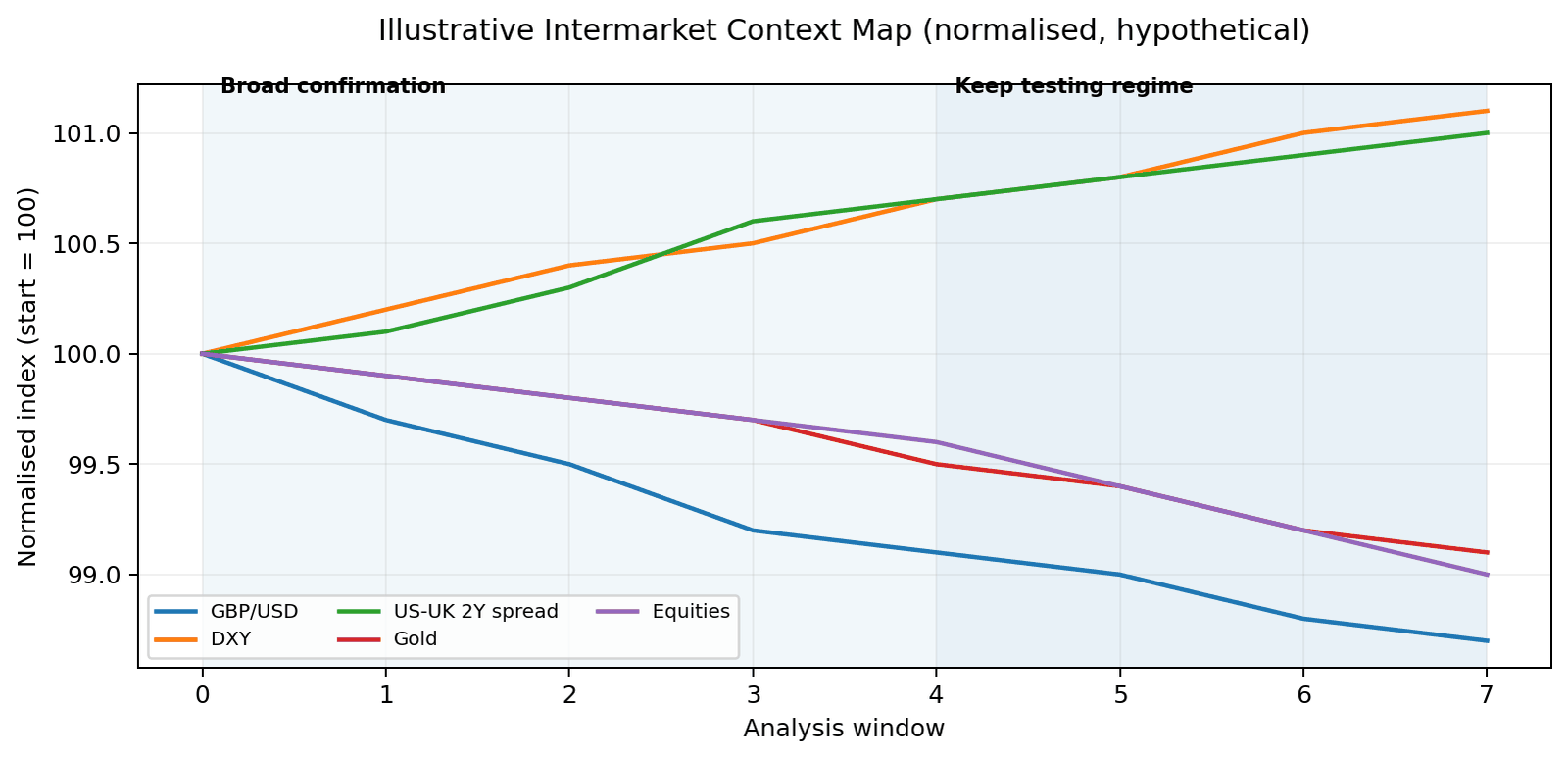
A practical intermarket analysis workflow for forex
- Define the currency pair, analysis timeframe and specific decision being evaluated.
- Choose two to four relevant intermarkets and write down why each belongs in the analysis.
- Record direction, trend strength and the latest macro catalyst rather than only the current price level.
- Classify each input as confirming, conflicting or neutral. Do not force every market into agreement.
- Return to the FX pair, market structure and economic calendar; define invalidation and execution risk independently.
- Record when the relationship fails so the process can be reviewed rather than rationalised after the fact.
What to do when intermarket signals conflict
Conflicting signals are not a problem to hide; they are information. Suppose DXY is stronger and the US 2-year yield is higher, but gold is also stronger while equities are falling sharply. The markets may be reacting to the same stress event through different channels, the pair’s counter-currency may have a stronger catalyst, or the relationship may be transitioning.
| Observation | Diagnostic question | Process response |
|---|---|---|
| Most relevant markets agree | Is there one plausible macro driver linking them? | Use the agreement as context, then return to the FX pair. |
| One market conflicts | Is the conflict explained by its own driver or timeframe? | Reduce confidence and investigate rather than ignoring it. |
| Several markets conflict / regime unclear | Is the original transmission channel still valid? | Treat “no clear conclusion” as a legitimate outcome. |
Worked example: hypothetical GBP/USD cross-market review
This example is deliberately hypothetical and is not a historical market claim or trading recommendation.
| Input | Hypothetical observation | Interpretation question |
|---|---|---|
| GBP/USD | 1.2750, below a recent 4H swing high | Is the pair weakening because of USD strength, GBP weakness or both? |
| DXY | Up 0.6% over the same window | Is broad USD strength visible beyond GBP/USD? |
| US 2-year yield | Up 12 basis points | Are US rate expectations repricing higher? |
| UK 2-year gilt yield | Up 3 basis points | Is the US-UK short-rate differential moving toward USD? |
| Gold | Down 0.8% | Does gold broadly fit firmer USD / higher-yield context without serving as causal proof? |
| Equities | Broad index down 1.0% | Is risk sentiment also deteriorating? |
The US 2-year yield rose 9 basis points more than the UK 2-year yield over the chosen window (12 bp – 3 bp = 9 bp). DXY and the relative short-rate move point in the same broad USD direction, while weaker equities suggest an additional risk-aversion channel. Lower gold is consistent with the same broad narrative here, but it is supporting context rather than independent proof.
A cautious interpretation is that the cross-market evidence supports a stronger-USD backdrop for GBP/USD. The next step is still to check GBP-specific information, the pair’s own structure, scheduled event risk and the execution plan. If the yield spread reverses, UK-specific news emerges or the pair invalidates the setup, the intermarket hypothesis needs to be reassessed.
Limitation: All observations are sensitive to the selected window. Intermarket agreement does not establish a stable correlation coefficient, does not guarantee a profitable entry and does not remove spread, slippage or event risk.
Limitations of intermarket analysis
| What intermarket analysis can add | What it cannot establish by itself |
|---|---|
| A structured view of broad USD, rates, commodity and risk channels. | Causation or a permanent correlation rule. |
| Evidence that several markets are responding to a common macro theme. | An entry, stop-loss, position size or profit target. |
| A way to identify confirmation, divergence or regime change. | A guarantee that the same relationship will persist on another timeframe. |
| A reason to investigate a counter-currency or event catalyst. | A substitute for pair-specific structure and execution analysis. |
Turn Trading Calculations Into Real Trading Decisions
Use your calculated risk levels, position sizing, and technical analysis together with live forex trading signals and market commentary from The Forex Complex.

Frequently asked questions
What is intermarket analysis in forex?
It is a cross-market framework that compares relevant assets such as DXY, sovereign yields, gold, oil and equities to understand macro drivers affecting a currency pair. The relationships are contextual and can change by regime.
Which markets should forex traders compare?
Use only markets with a clear economic link to the pair and question. Common inputs include a relevant dollar measure, sovereign yields, selected commodities, equities and sometimes volatility or credit measures.
Do higher bond yields always strengthen a currency?
No. Relative yields and expected policy paths can matter, but inflation expectations, risk flows and common data catalysts can change the relationship.
Is gold always inversely correlated with DXY?
No. Gold and the US dollar can move in opposite directions in some regimes and strengthen together in some stress episodes. The sample, timeframe and macro driver matter.
Why can oil matter for USD/CAD?
Oil can influence Canada through export revenues, investment, inflation and terms of trade. USD/CAD also responds to broad USD moves and relative rate expectations, so oil is only one input.
How many intermarkets should I use at once?
A small set with clear economic relevance is usually easier to interpret consistently. Adding unrelated charts increases noise and makes confirmation bias more likely.
Intermarket analysis is a context framework
The practical value of intermarket analysis is not a memorised correlation table. It is a repeatable process for asking whether broad dollar conditions, relative rates, commodities and risk assets support the same macro story or reveal a conflict. Start with the currency pair and a specific question, use only economically relevant markets, and treat disagreement as information rather than something to hide. Final trade decisions still require pair-specific structure, risk limits and realistic execution assumptions.




 Join Our Free Group

 Twitter