

In this article (15 sections)
- How do prop firms make money?
- Evaluation and challenge fees
- “Funded” does not always mean live capital
- How do prop firm payouts work?
- Where does the money for payouts come from?
- How risk models can affect prop-firm economics
- Rule breaches, drawdown and trader failure rates
- Scaling plans and larger account balances
- Forex/CFD prop firms vs futures prop firms
- Branded fee and payout queries: what to verify
- Can you write off prop firm fees?
- What to check before paying a prop-firm fee
- Worked example: simplified prop-firm unit economics
- Frequently asked questions
- Key takeaway
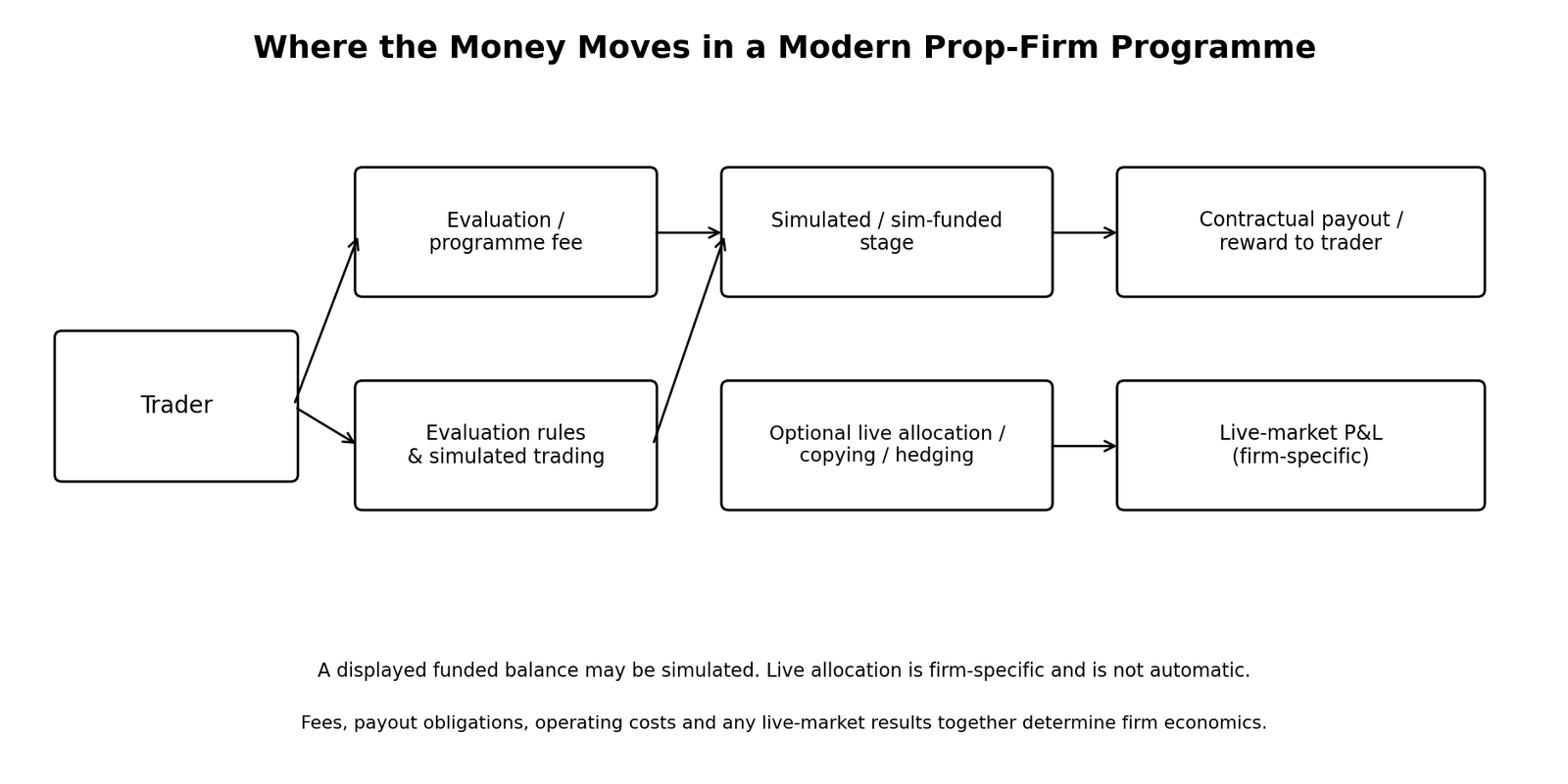
Prop firms can earn from evaluation or challenge fees, other programme charges where applicable, and the portion of eligible rewards they retain under a stated payout split. Some firms also use selected trader activity for live trading, copying or hedging. But many modern “funded” accounts remain simulated, so the displayed balance is not necessarily live firm capital. Business models vary, and fees, payout obligations, operating costs and any live-market P&L should be analysed separately.
How do prop firms make money?
The economics can come from several sources, and no single mix applies to every firm. Evaluation fees may pay for access to assessment rules, platforms, market data, analytics and operating infrastructure. Some programmes also charge reset, retry, activation, subscription, data or payment fees. When a trader qualifies for a payout, the programme may pay a stated share of eligible profit or simulated profit and retain the remainder under the contract. A firm may also generate gains or losses from live exposure if it copies, hedges or allocates selected traders to real capital.
| Economic source | How it works | When it matters | Main caveat |
|---|---|---|---|
| Evaluation / challenge fee | Trader pays for access to an assessment and programme infrastructure. | Before qualification. | May be refundable, credited or non-refundable; treatment varies by programme. |
| Reset / retry / activation / data fee | Additional access or infrastructure fee where offered. | After breach/retry or in certain product structures. | Not universal; verify the exact current programme. |
| Retained payout share | Trader receives a stated share of eligible reward; firm retains the balance under the contract. | At approved payout. | On simulated accounts this is not necessarily a split of real-market profit. |
| Live trading / copied exposure | Firm may replicate or allocate selected trader exposure in live markets. | Only where the firm actually does so. | Do not infer live copying from the word “funded”. |
Gross fees are not the same as net profit. Firms also bear payout obligations, platform and market-data costs, payment processing, staff, compliance, customer support, technology, affiliates/marketing, chargebacks and any live-trading or hedging losses.
Evaluation and challenge fees
An evaluation fee usually buys access to a defined assessment environment with profit targets, drawdown limits and other rules. Refund treatment can differ materially by product. As of 29 September 2026, FTMO states that its 2-Step Challenge fee can be refunded with the first Reward withdrawal, while its 1-Step fee is non-refundable. FTMO Futures uses a different structure again: a recurring monthly Evaluation subscription that ends after the Evaluation is passed. These examples show why fee terms should be checked at programme level rather than generalised across the industry.
Do not assume “failed trader fee = pure profit”. A retained fee can contribute to revenue, but the firm still has operating, payment, support, acquisition and payout costs.
“Funded” does not always mean live capital
Many online prop programmes continue to use simulated or demo accounts after the evaluation stage. A trader can receive real money under a reward or payout contract even though the underlying trades were not placed with the advertised account balance in live markets. FTMO currently states that its standard CFD FTMO Accounts use fictitious capital, while its futures programme distinguishes Sim-Funded Accounts from Live Funded Accounts. In the futures programme, progression to live capital is discretionary and available only to a selected group of traders.
| Dimension | Simulated / sim-funded | Live funded |
|---|---|---|
| Capital | Fictitious/demo/notional balance; prices may still be based on real markets. | Actual firm capital is placed into live-market trading. |
| Trader result | Used to calculate eligibility for a contractual reward or payout. | Creates actual market P&L under the live account structure. |
| Firm market risk | No one-for-one market exposure is required by the simulated account itself. | Firm bears live trading risk unless separately hedged. |
| What to verify | Terms explicitly saying simulated/demo/fictitious and reward conditions. | Live-account agreement, broker/exchange structure and allocation terms. |
A “$100K funded account” may be a simulated risk-limit framework, not $100,000 deposited into a brokerage account for that trader.
How do prop firm payouts work?
A prop firm payout is generally a contractual payment once the trader meets the programme’s eligibility rules. Depending on the provider, those rules can include minimum account age or trading days, closed positions, minimum profit, consistency requirements, drawdown buffers, payout caps, identity checks and payment-method requirements. “On demand” usually means the trader may submit a request once conditions are met; it does not necessarily mean instant or unconditional payment.
| Rule | Questions to verify |
|---|---|
| Eligibility | Minimum days/account age? Minimum profit? Closed positions? KYC or compliance review? |
| Split / ratio | What percentage is paid to the trader, and can it change by programme or scaling tier? |
| Frequency | Biweekly, monthly, on-demand after eligibility, or another cycle? |
| Minimum / cap | Minimum withdrawal? Maximum per cycle? Percentage cap? |
| Consistency / buffer | Any consistency rule, drawdown buffer or profit-distribution condition? |
| Method / fee | Bank, card, crypto or provider such as Rise? Who charges any processing fee? |
Current first-party examples illustrate the variation. FTMO’s standard CFD reward page states that a reward can be requested from day 14 after the first trade, with programme-specific reward ratios. The5ers publishes programme-specific rules: its general withdrawal guide states a first withdrawal can be requested 14 days after a funded account is activated, while its futures material sets separate eligibility and payout caps. These are provider examples, not universal industry rules.
Where does the money for payouts come from?
In a simulation-led model, payouts can be funded from the firm’s overall cash flows, which may include evaluation/programme revenue and other operating income. If the firm separately copies or hedges selected trader exposure in live markets, live-market gains or losses can also affect the firm’s economics. A payout based on simulated performance does not prove that the same trade was executed externally, and the article should not claim that one failed trader directly funds one successful trader without company-level evidence.
How risk models can affect prop-firm economics
| Model | What happens | Economic implication | Main caveat |
|---|---|---|---|
| Simulation-only | Trader remains in a simulated environment. | Firm mainly faces contractual payout liability plus operating costs. | No live P&L should be inferred from the simulated trades. |
| Selective copying / hedging | Firm uses analytics to replicate or hedge some exposure. | Live P&L can add to or reduce programme economics. | Live fills, sizing, netting and timing can differ from simulated results. |
| Live funded allocation | Selected traders receive a real-capital stage. | Firm bears actual live-market exposure under the account structure. | Only describe this where current terms explicitly support it. |
FTMO is an example of why these layers should be separated. Its CFD FAQ says client FTMO Accounts are demo accounts with fictitious capital, while FTMO may separately use client trading data when deciding what to trade for its own account. Its futures product explicitly labels Sim-Funded and Live Funded stages as different account types.
Rule breaches, drawdown and trader failure rates
Maximum drawdown, daily-loss limits, trailing drawdown, consistency requirements and prohibited-strategy rules can end or restrict an account before payout eligibility. On a simulated account, a breach does not create a live-market loss equal to the advertised account balance. If a fee is non-refundable after breach, the firm may retain that programme revenue subject to its costs; if a fee is refunded or credited after success, the economics are different.
There is no reliable universal “90% fail” statistic for prop firms. Any pass, failure or payout rate needs a named programme, period, denominator, treatment of resets/repeat purchases and a reproducible methodology.
Scaling plans and larger account balances
Scaling can increase a displayed account balance, loss limits, reward ratio or programme tier after performance criteria are met. But a larger displayed balance does not by itself prove that the firm committed an equal amount of live capital. The useful checks are the new notional balance, drawdown rules, payout ratio and cap, and whether the programme explicitly changes the trader from simulated to live capital.
Forex/CFD prop firms vs futures prop firms
The product structure can differ. Forex/CFD-style programmes often use one-time challenge fees, while some futures programmes use subscriptions, activation/data fees or other arrangements. Many futures programmes also use a simulated Evaluation and simulated funded stage before any discretionary live-capital step. Payout rules can include minimum days, consistency rules, payout caps or account-age requirements. Because fees and rules change quickly, current provider documentation should be checked instead of publishing a permanent “best futures challenge fee” ranking in an evergreen explainer.
Branded fee and payout queries: what to verify
| Query / entity | What to verify | Why |
|---|---|---|
| FTMO fee | Programme type, region, billing currency, current refund rule and checked date. | FTMO 1-Step, 2-Step and Futures use different pricing/refund structures. |
| The5ers payout | Exact programme, minimum, cycle, cap, profit split and method fee. | Rules differ by product and can be updated. |
| Rise payout | Whether Rise is only the payout/payroll provider for the named firm. | Rise provides payout infrastructure; the prop firm sets programme eligibility. |
| Payout statistics | Source, period, cohort, denominator and methodology. | Marketing totals are not a universal pass/failure or payout rate. |
Rise describes itself as payroll/payout infrastructure for prop firms, including contractor and stablecoin payment tooling. It should therefore be treated as a payment provider in this context, not as the entity setting a trader’s challenge or payout-eligibility rules.
Can you write off prop firm fees?
There is no universal tax answer. Deductibility depends on jurisdiction, taxpayer status, whether the activity is carried on as a trade or business, and the nature of the expense. UK HMRC guidance allows qualifying business expenses for self-employed activity subject to the relevant rules; US IRS guidance generally requires deductible business expenses to be ordinary and necessary. Neither source automatically classifies every prop evaluation fee as deductible. Keep receipts and programme records and obtain qualified tax advice for your circumstances.
What to check before paying a prop-firm fee
- Is the evaluation/funded account simulated, live, or able to transition to live, and where is that stated?
- What exactly does the fee buy, and is it refundable, credited or non-refundable?
- What are the maximum-loss, daily-loss, consistency, news, holding and prohibited-strategy rules?
- What must be satisfied before a payout request, including split, minimum, cap, cycle and processing fee?
- Does scaling change only the simulated balance/risk limits, or does it change live allocation?
- Are payout/pass statistics independently defined by period and cohort, or are they marketing totals?
- Which legal entity contracts with the trader, and what are the refund, dispute and payment terms?
Worked example: simplified prop-firm unit economics
Hypothetical example only. All evaluation and post-evaluation accounts below are simulated; the figures do not describe any named firm.
| Input | Illustrative value |
|---|---|
| Evaluation attempts | 100 |
| Fee per attempt | £100 |
| Gross evaluation-fee receipts | £10,000 |
| Traders reaching payout eligibility | 10 |
| Eligible simulated profit per trader | £1,000 |
| Trader payout ratio | 80% |
| Fee refunds | 2 × £100 |
Payout obligation: 10 × £1,000 × 80% = £8,000. Fee refunds: 2 × £100 = £200. Gross fee receipts less those two obligations: £10,000 – £8,000 – £200 = £1,800 before platform/data charges, payment fees, staff, marketing, affiliates, technology, chargebacks, taxes, reserves and other operating costs.
The retained 20% of simulated profit is part of the contractual reward calculation, not evidence of £2,000 of live-market trading profit. If the hypothetical firm separately copied some qualifying traders into live markets, that live portfolio could add gains or losses independently. If it copied none, those simulated trades would create no live-market P&L.
The headline funded balance is not the same as the firm’s cash exposure. Programme profitability depends on fee/refund behaviour, payout obligations, acquisition and operating costs, and any firm-specific live risk model.
Turn Trading Calculations Into Real Trading Decisions
Use your calculated risk levels, position sizing, and technical analysis together with live forex trading signals and market commentary from The Forex Complex.

Frequently asked questions
How do prop firms make money?
Prop firms can earn from evaluation or programme fees, other charges where applicable, and the portion of eligible rewards they retain under the contract. Some firms also generate live-market gains or losses by copying, hedging or allocating selected traders. Business models vary, and many funded accounts are simulated.
How do prop firm payouts work?
A payout is generally a contractual payment after the trader satisfies programme rules such as account age, profit, drawdown, consistency and verification requirements. The split, minimum, cap, frequency and payment method vary by programme.
Do prop firms use real money?
Sometimes. Many evaluation and funded accounts are simulated, while some programmes can move selected traders to a live-capital stage. Check the provider’s current legal terms rather than inferring from the displayed balance.
What happens to the challenge fee if I pass?
It depends on the programme. Some firms refund or credit a fee after qualification or the first payout; others use non-refundable fees. The exact current rule must be checked.
What does “payout on demand” mean?
Usually it means an eligible trader may submit a payout request without waiting for a fixed monthly date. Minimum days, drawdown buffers, review and processing time can still apply.
Can I write off prop firm fees on my taxes?
Potentially in some business situations, but there is no universal rule. Tax treatment depends on jurisdiction and facts, so use official guidance and a qualified adviser rather than assuming every challenge fee is deductible.
Key takeaway
Modern prop-firm economics are easiest to understand by separating three layers: programme fees, contractual payouts and any live-market risk the firm chooses to take. A simulated funded account can generate real payouts without the displayed balance being live capital. Fees can matter materially, but “firms only profit when traders fail” is too simplistic without audited company-level evidence. The most reliable due diligence is to read the current programme terms, payout rules, refund policy and legal entity disclosures.




 Join Our Free Group

 Twitter