

In this article (13 sections)
- How do forex brokers make money?
- Spreads: the most visible embedded trading cost
- Commissions and markups
- Swaps and overnight financing
- A-book, B-book and hybrid models
- Does a B-book broker make money when clients lose?
- STP, ECN and dealing desk: what the labels actually tell you
- Where conflicts of interest can arise
- How to check how a forex broker gets paid
- Worked example: visible trading cost vs broker risk model
- Common misunderstandings about broker revenue
- Frequently asked questions
- Key takeaway
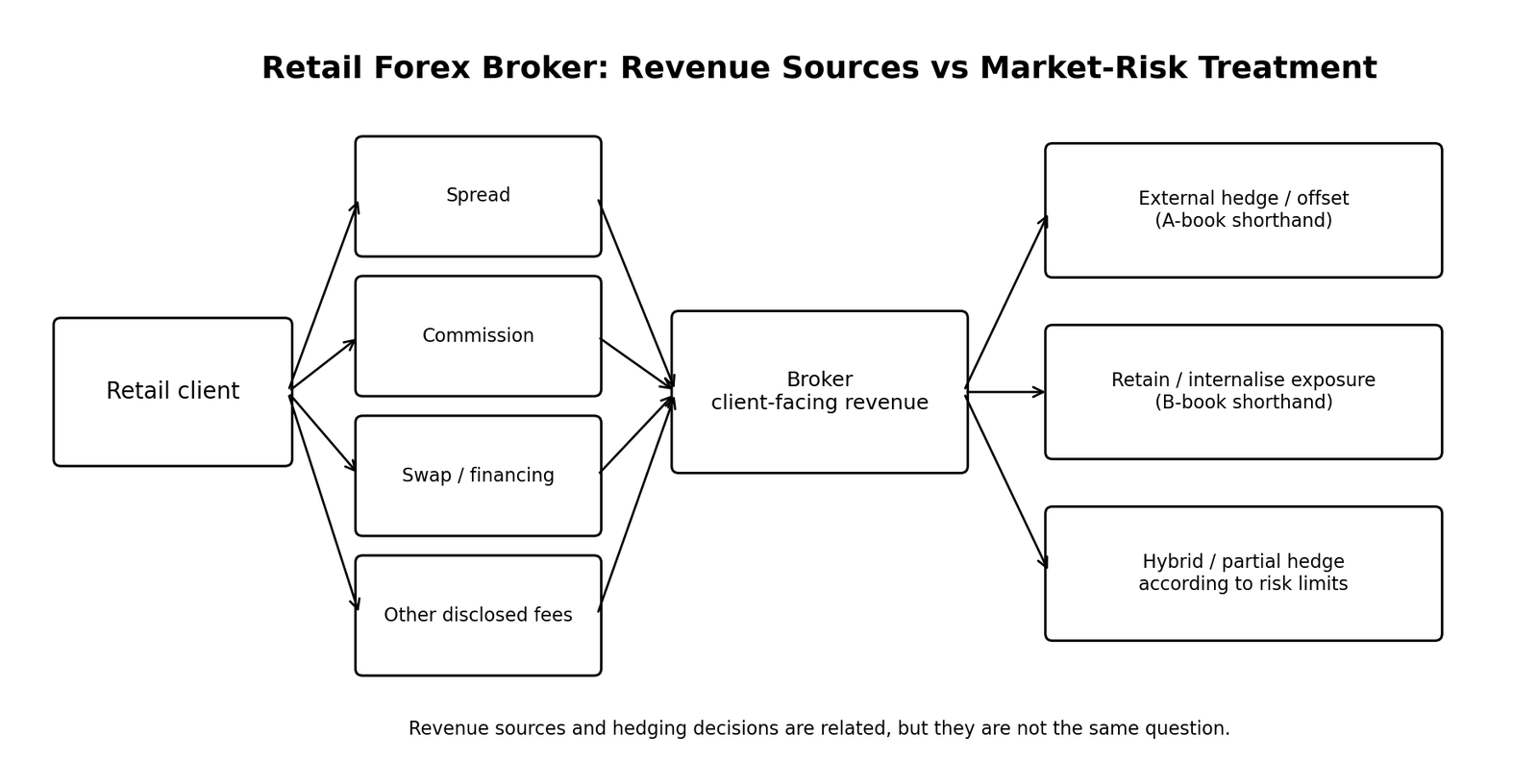
Forex brokers can make money from spreads, commissions, overnight financing or swap adjustments, price markups and other disclosed fees. Separately, a broker may hedge client exposure externally, internalise it, or use a hybrid of both. Those risk-management choices are often described as A-book and B-book, but the labels alone do not tell you the broker’s total costs, execution quality or how well conflicts of interest are managed.
How do forex brokers make money?
A retail forex or CFD broker can earn transaction revenue through several channels, often on the same account. The most common are the bid/ask spread, explicit commission, pricing markups or markdowns, overnight financing adjustments and other account fees disclosed in the broker’s terms. Revenue is not the same as net profit: firms also bear liquidity, hedging, financing, technology, regulatory, staffing and customer-acquisition costs.
| Revenue source | What the client sees | Broker economics | Main caveat |
|---|---|---|---|
| Spread | Difference between bid and ask | May include dealing margin or compensation for quoting/execution | Gross spread is not automatically net profit. |
| Commission | Explicit fee per side, round turn, lot or notional | Direct transaction revenue | The unit must be stated; “$X commission” alone is ambiguous. |
| Markup / markdown | Client price differs from an external or reference price | Pricing adjustment on externally sourced liquidity | Disclosure and terminology vary by jurisdiction and account. |
| Swap / financing | Debit or credit when a position crosses rollover | May include financing economics and broker methodology/markup | The full client debit should not be assumed to be broker margin. |
| Other fees | Conversion, inactivity, data or account charges where applicable | Ancillary account revenue | Only count fees the broker actually discloses. |
Spreads: the most visible embedded trading cost
The spread is the difference between the bid and ask. A spread-based account can look “commission-free” while still charging a real transaction cost through the quoted prices. A broker may quote wider than an underlying liquidity-provider market, internalise flow, or combine spread revenue with other charges. In the US retail-forex context, current NFA Rule 2-36 requires transaction disclosures that distinguish commissions/fees, STP markups or markdowns, and the midpoint spread cost for non-STP transactions. Those US disclosure rules should not be generalised to every jurisdiction.
“Zero commission” does not mean zero trading cost. Compare spread, commission, financing, conversion and any other disclosed charges together.
Commissions and markups
Commission-based accounts
Some accounts quote relatively narrow spreads and charge an explicit commission. When comparing examples, always identify whether the fee is per side, round turn, lot or notional amount. The same headline commission can mean different total cost under different conventions.
Markups and markdowns
A broker that receives an external price can add a markup or markdown before presenting or filling the client. NFA’s current US retail-forex rules explicitly address applicable STP markups/markdowns for Forex Dealer Members, which illustrates why an “STP” label does not mean the retail price must equal an upstream liquidity-provider price.
Swaps and overnight financing
Positions held across a broker’s rollover cut-off may receive or pay an overnight financing or swap adjustment. The amount can differ for long and short positions, and some platforms show day-of-week multipliers. MetaTrader 5’s current symbol specification includes swap calculation details, separate swap-long and swap-short fields, and swap multipliers by day. These platform fields describe account mechanics; they do not reveal how much of the client debit becomes broker margin after upstream financing and hedging costs.
- Check the symbol/account specification for swap calculation method, long and short values, rollover day multipliers and the relevant account currency.
- If an account is described as “swap-free”, read the alternative administrative or holding-fee terms rather than assuming financing economics disappear.
A-book, B-book and hybrid models
A-book and B-book are widely used industry shorthand for how a broker handles client market exposure. They are useful descriptions, but they are not universal legal classifications. Regulatory material more often describes whether provider exposure is fully hedged, unhedged/internalised or partially hedged.
| Model shorthand | Typical risk treatment | Possible economics | Important limitation |
|---|---|---|---|
| A-book | Exposure is externally hedged or offset, one-for-one or in aggregate. | Spread, commission, markup, financing, plus residual hedging/basis economics. | Does not prove each retail order is mirrored individually or guarantee better execution. |
| B-book | Some or all exposure is retained/internalised instead of immediately hedged. | Transaction revenue plus dealing P&L on retained exposure. | Creates a potential counterparty conflict; client loss is not automatically equal to final firm profit. |
| Hybrid | Some exposure is internalised and the rest hedged according to net flow or risk limits. | Combination of transaction revenue and retained/hedged dealing economics. | Routing and hedging can change over time and may not be visible trade by trade. |
Does a B-book broker make money when clients lose?
If a broker is the counterparty and leaves a specific client exposure unhedged, the market P&L on that retained exposure can move opposite to the client’s P&L. That creates a real structural conflict that must be identified and managed under applicable rules. But the firm’s total economics are more complex than one client trade: it can net opposing client positions, hedge only net exposure, change hedge ratios as limits change, and earn spreads, commission or financing regardless of whether a particular client wins or loses.
A client loss is not automatically identical to the broker’s final net profit. The correct question is how the exposure was netted, hedged and costed, and what controls exist around the conflict.
STP, ECN and dealing desk: what the labels actually tell you
| Label | What it may describe | What it does not prove |
|---|---|---|
| STP | An automated routing/offsetting workflow; in the US NFA rules give STP a specific regulatory definition for FDMs. | That every jurisdiction uses the term identically, or that the broker never acts as counterparty. |
| ECN | Electronic matching/access infrastructure or an account marketed around such liquidity. | That the retail broker is pure agency, never internalises flow, or has the lowest total cost. |
| Dealing desk / market maker | Dealer involvement in pricing and/or client risk management. | That the firm never hedges externally, or that manipulation has occurred. |
A broker can remain the legal counterparty to the retail client while separately offsetting its market risk with a liquidity provider. That is why legal counterparty status, execution routing and A/B-book shorthand should be checked separately.
Where conflicts of interest can arise
Conflict does not equal misconduct. It means the firm may have an incentive that differs from the client’s interests and therefore needs appropriate controls. In the UK, FCA SYSC 10 requires firms within scope to identify and prevent or manage conflicts of interest, including conflicts created by remuneration and incentive structures. The FCA’s CFD materials also continue to highlight conflicts inherent in CFD-provider business models and the risks created when firms benefit from customers trading more frequently or in larger size.
| Potential conflict | Possible incentive | What to check |
|---|---|---|
| Retained client exposure | Dealer P&L can move opposite to client P&L on unhedged risk. | Conflict policy, client agreement, execution policy and governance disclosures. |
| Volume-based revenue | More trades can generate more spread/commission revenue. | Pricing schedule, inducements, sales practices and Consumer Duty/appropriateness disclosures where relevant. |
| Price/execution discretion | Asymmetric handling of slippage, stops or quotes can disadvantage clients. | Execution policy, positive/negative slippage data and regulatory history. |
| Financing / fees | Revenue can increase with holding time or account activity. | Swap table, fee schedule, rollover method and account-specific terms. |
How to check how a forex broker gets paid
- Confirm the exact legal entity and regulator authorisation rather than relying on the brand name alone.
- Read the costs-and-charges or fee schedule for spreads, commissions, overnight financing, conversion and non-trading fees.
- Read the order-execution policy and client agreement for principal/counterparty wording, execution venues, price sources and order handling.
- Check product specifications for spread type, swap long/short, rollover multipliers and commission units.
- Look for execution-quality, slippage or rejection disclosures where available instead of focusing only on headline spread.
- Ask whether terms such as STP, ECN, A-book or “no dealing desk” are defined in contractual documents or only in marketing copy.
Worked example: visible trading cost vs broker risk model
Hypothetical EUR/USD example. The figures are educational only and are not a broker quote or recommendation.
| Input | Illustrative value |
|---|---|
| Position size | 1 standard lot EUR/USD |
| Pip-value assumption | $10 per pip |
| Entry spread | 0.8 pip |
| Commission | $3.50 per side |
| Holding period | Closed same day; no overnight swap |
Spread cost: 0.8 × $10 = $8. Commission: $3.50 entry + $3.50 exit = $7. Simplified visible transaction cost: $15 before slippage, conversion or other charges.
That $15 tells you something about disclosed transaction pricing, but it does not tell you whether the broker externally hedged the exposure, retained it or used a hybrid approach. If exposure is hedged, the broker also faces hedge and liquidity-provider economics. If exposure is retained, dealing P&L can move opposite to the client. A hybrid broker may hedge only part of the net exposure or hedge after an internal limit is reached.
Common misunderstandings about broker revenue
| Claim | More accurate interpretation |
|---|---|
| “Zero commission means free trading.” | Costs can still be embedded in spread, markup, financing, conversion or other disclosed charges. |
| “A-book means every order goes one-for-one to a bank.” | External hedging can be aggregated; the shorthand does not prove one-to-one mirroring. |
| “B-book means manipulation.” | Internalisation creates a structural conflict but does not itself prove improper conduct. |
| “STP or ECN removes conflicts.” | Routing/connectivity labels do not reveal every counterparty, hedging or incentive arrangement. |
| “All swap debits are broker profit.” | The broker may have upstream financing and hedging costs; the full client debit is not automatically margin. |
Turn Trading Calculations Into Real Trading Decisions
Use your calculated risk levels, position sizing, and technical analysis together with live forex trading signals and market commentary from The Forex Complex.

Frequently asked questions
How do forex brokers make money from spreads?
The bid/ask spread is an embedded transaction cost. A broker can earn economics from its quoted spread or markup, but the gross spread should not be treated as pure net profit because external pricing, hedging and operating costs may apply.
What is the difference between A-book and B-book?
A-book is industry shorthand for externally hedging or offsetting client market exposure. B-book describes retaining or internalising some or all exposure. Hybrid models combine both approaches.
Are B-book brokers bad?
The label alone does not establish quality or misconduct. Retained exposure can create a structural conflict, so the useful checks are execution policy, costs, conflict controls, legal entity and measurable execution evidence.
Is an ECN broker always A-book?
No. ECN can describe matching or liquidity-access infrastructure, while the broker’s legal counterparty status and hedging decisions are separate questions.
Do forex brokers earn money from swaps?
They may receive financing economics or apply their own methodology or markup, but the full client debit should not be described as broker profit without evidence of upstream financing and hedging costs.
What should I check before choosing a forex broker?
Verify the legal entity and regulator, total costs and charges, execution policy, client agreement, spread/commission/swap specifications and execution-quality disclosures where available.
Key takeaway
Forex broker economics are easiest to understand when you separate two questions: what the client is charged, and how the broker manages the market exposure created by client positions. Spreads, commissions, financing and markups describe revenue sources. A-book, B-book and hybrid describe risk treatment. STP, ECN and dealing-desk labels describe aspects of routing or execution, but they do not substitute for reading the legal entity’s actual pricing, client agreement, execution policy and conflict disclosures.




 Join Our Free Group

 Twitter