

In this article (14 sections)
- What is a ranging market in forex?
- How to identify a ranging market
- Mark the range high, range low and midpoint
- A practical forex range trading workflow
- Mean reversion near range boundaries
- False breakouts vs confirmed breakouts
- How oscillators can support range analysis
- Using ATR to judge range width and volatility
- Asian range trading strategy – what the term usually means
- When a range stops being a range
- Worked example: hypothetical EUR/USD range
- Range trading risks and common mistakes
- Frequently asked questions
- Key takeaway
A ranging market forms when price repeatedly trades between identifiable upper and lower boundaries without sustaining a directional breakout. Range trading focuses on how price behaves around those boundaries, but a touch of support or resistance is not an automatic entry. A robust process defines the range, the confirmation rule, the invalidation rule and the conditions that would end the range regime before any trade is considered.
| Core principle |
|---|
| Treat the range as a current market regime, not a promise that price will keep rotating. Boundary touches, oscillator extremes and false-break labels are context only until the article’s predefined confirmation rule is met. |
What is a ranging market in forex?
A ranging market is a period in which price oscillates between an identifiable upper boundary and lower boundary without establishing sustained directional expansion. The clearest ranges usually show repeated reactions at both sides, overlapping swings and weak follow-through beyond the edges. A brief pause inside a strong trend is not automatically a mature range.
- Ranges can be horizontal, slightly sloped or irregular, but this article focuses on clearly bounded sideways structures.
- A range is not proven by one bounce from support and one rejection from resistance; repeated interaction makes the boundaries more meaningful.
- Ranges can exist on any timeframe, and a lower-timeframe range can sit inside a higher-timeframe trend.
| Feature | Trending market | Ranging market | Transition warning |
|---|---|---|---|
| Swing structure | More persistent HH/HL or LH/LL sequence | Overlapping swings between boundaries | Direction starts holding outside the old boundary |
| Follow-through | Directional moves extend | Breaks often fail or return inside | Repeated closes/follow-through beyond one side |
| Primary question | Is trend structure intact? | Are the boundaries still accepted? | Has the regime changed? |
How to identify a ranging market
- Mark the most obvious recent swing high and swing low on one consistent timeframe.
- Look for repeated reactions inside those boundaries and overlapping swings rather than clean directional structure.
- Check whether the range is wide enough relative to spread and recent volatility to make boundary analysis meaningful.
- Keep the same boundaries until your predefined invalidation rule is met instead of redrawing them after every wick.
- Reclassify the market when closes and follow-through begin to establish structure outside the range.
| Condition | What to look for | What weakens the range thesis |
|---|---|---|
| Upper boundary | Repeated rejection or failed acceptance above | Successive closes holding above |
| Lower boundary | Repeated rejection or failed acceptance below | Successive closes holding below |
| Internal structure | Overlapping swings / rotations | Persistent directional swing sequence |
| Volatility | Stable or compressed relative behaviour | Expansion plus directional follow-through |
Mark the range high, range low and midpoint
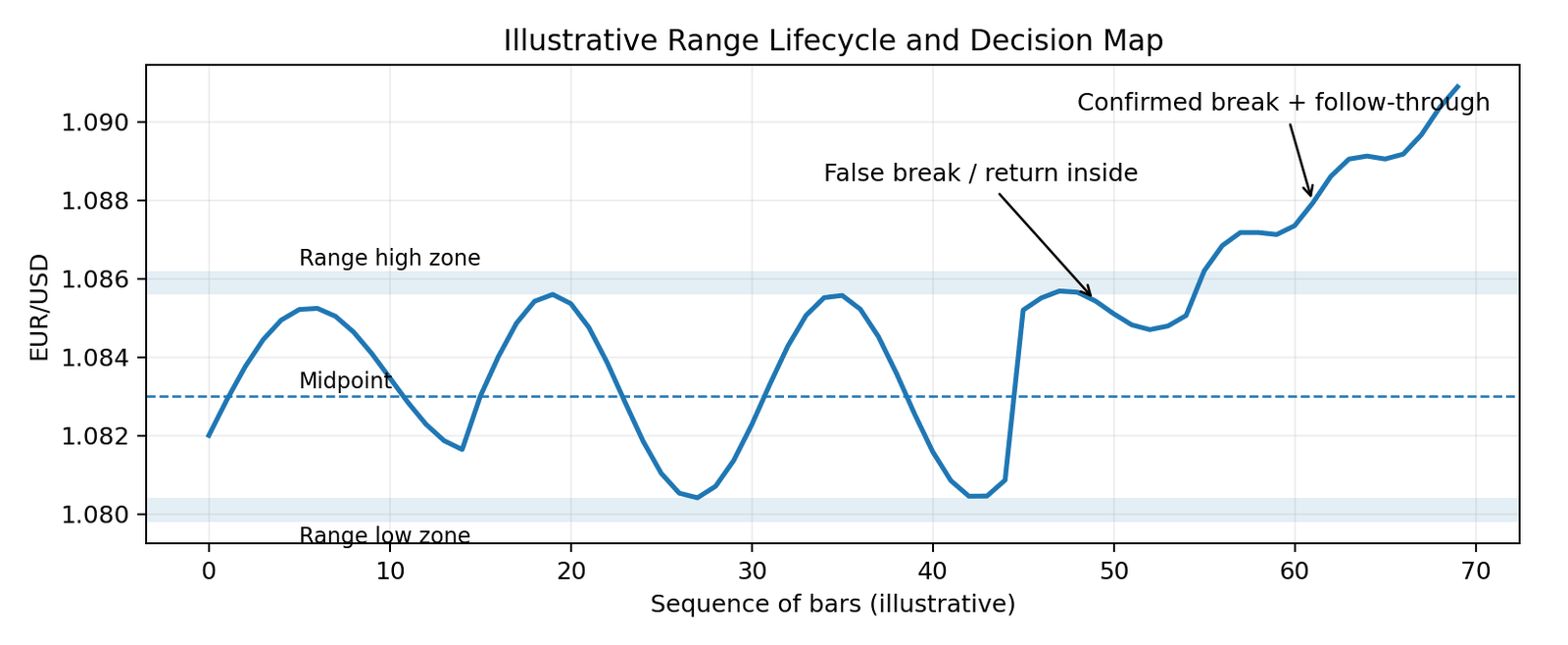
Treat range edges as zones rather than exact prices. The upper rejection/acceptance area becomes the range-high zone and the lower area the range-low zone. If useful, the midpoint can be calculated as:
Midpoint = (Range High + Range Low) / 2
The midpoint is an organisational reference, not a guaranteed magnet or target. The range zones should remain fixed until the stated invalidation rule is met.
A practical forex range trading workflow
- Confirm that the market still qualifies as a range under the chosen identification rule.
- Mark the upper and lower boundary zones and, if useful, the midpoint.
- Decide which boundary interaction creates a setup and what confirmation is required.
- Define invalidation before entry. In this article, a confirmed breakout means a candle close beyond the boundary followed by either follow-through or a successful retest outside the old range.
- Check spread, scheduled event risk and recent volatility before placing an order.
- Use a preplanned exit framework such as midpoint, opposite boundary or structural failure; do not assume price must cross the whole range.
- Stop applying range-trading logic once the breakout/invalidation rule is satisfied.
Mean reversion near range boundaries
Mean-reversion logic assumes price may rotate back towards the centre of an established range after rejection near an edge. That is a hypothesis, not a signal. The location becomes useful only when paired with a predefined confirmation rule.
| Location | Observation | Possible interpretation | Required confirmation | Invalidation |
|---|---|---|---|---|
| Near range low | Price probes lower zone | Potential mean reversion | Rejection + close back inside / predefined micro-structure trigger | Confirmed break below range |
| Near midpoint | Price is centrally located | Weak directional edge | Usually wait for clearer location | N/A |
| Near range high | Price probes upper zone | Potential mean reversion | Rejection + close back inside / predefined micro-structure trigger | Confirmed break above range |
False breakouts vs confirmed breakouts
Ranging markets often produce brief breaches. A wick beyond a boundary may be a volatility excursion, but it does not prove a “liquidity grab” or institutional intent. This article uses a close-based convention: a wick alone does not confirm a breakout; a close outside is stronger evidence, and confirmation is improved by follow-through or a retest that holds outside the prior range.
| Price behaviour | Close | Follow-through / retest | Range status |
|---|---|---|---|
| Wick outside, close back inside | Inside | None | Range can remain valid |
| Close outside, immediate return | Outside then back inside | Fails | Failed break; range may remain valid |
| Close outside + continued acceptance | Outside | Holds / retest succeeds | Prior range invalidated |
How oscillators can support range analysis
RSI, Williams %R or Stochastic can add momentum context near an existing range boundary. Overbought or oversold readings can persist, so they should not be treated as automatic fade signals. Divergence can warn that momentum is changing, but it does not guarantee a reversal.
| Tool | What it measures | Useful range context | Main limitation |
|---|---|---|---|
| RSI / Williams %R / Stochastic | Momentum or position within a recent price range | Secondary context near a known boundary | Extreme readings can persist; overlapping information |
| Price structure | Actual boundary reactions and swings | Primary range definition and invalidation | Still uncertain and sensitive to chosen timeframe |
Using ATR to judge range width and volatility
Average True Range (ATR) measures recent price-range volatility; it does not identify direction. Comparing range width with recent ATR can help describe whether the range is relatively broad or narrow for the current regime. There is no universal ATR ratio that defines a valid range.
| Condition | Possible interpretation | Caution |
|---|---|---|
| Range width large relative to recent ATR | More room between boundaries | Still no guarantee the range will hold |
| Range width narrow relative to recent ATR | Compression / limited room | More vulnerable to quick expansion and execution noise |
| ATR rising while boundary failures increase | Possible regime transition | Needs price-based confirmation |
Asian range trading strategy – what the term usually means
“Asian range” commonly refers to the high-low span formed during a defined Asia-session window before later sessions become more active. Some traders watch that range for later mean reversion or breakout behaviour, but neither outcome is guaranteed. Exact session hours depend on the reference timezone, broker/server chart settings and daylight-saving changes in other financial centres, so the window must be defined explicitly rather than treated as universal.
Scheduled Asian, UK, European or US data can also change the usual volatility pattern. The session label therefore provides context only; it does not turn a range into a reliable breakout or fade system.
When a range stops being a range
- Repeated closes outside one boundary and sustained follow-through.
- A break-and-retest that holds outside the former range.
- New swing structure developing beyond the old boundary.
- Volatility expansion accompanied by wider directional candles.
- Repeated boundary failure rather than one isolated wick.
Once the invalidation rule is met, stop fading the old boundary simply because it worked before. Wait for a new structure to form before applying range logic again.
Worked example: hypothetical EUR/USD range
| Input / observation | Illustrative value | Interpretation |
|---|---|---|
| Range low | 1.0800 | Lower boundary after several prior rejections |
| Range high | 1.0860 | Upper boundary after several prior rejections |
| Range width | 60 pips | 1.0860 – 1.0800 = 0.0060 |
| Midpoint | 1.0830 | Organisational reference, not guaranteed target |
| Hypothetical confirmation | Trade to 1.0804, rejection, later close above 1.0810 | Could satisfy predefined rejection trigger |
| Illustrative entry reference | 1.0810 | For arithmetic only |
| Illustrative invalidation | 1.0790 | 20 pips below entry reference |
| Midpoint distance | 20 pips | 1R gross before costs |
| Upper inner target reference | 1.0850 | 40 pips or 2R gross before costs |
This example shows how the range, midpoint, confirmation and invalidation can be defined before entry. It does not imply that a range-low rejection should automatically be bought. Spread, slippage, gaps and news can change realised risk/reward, and neither midpoint nor opposite boundary is guaranteed to be reached.
Range trading risks and common mistakes
| Mistake | Why it matters | Process control |
|---|---|---|
| Entering near the middle | Less room before the next decision boundary | Wait for a planned location |
| Assuming old support/resistance must hold | Past reactions do not guarantee future ones | Use explicit confirmation + invalidation |
| Redrawing boundaries after entry | Hides the failure of the original thesis | Freeze the range until invalidation |
| Ignoring news / execution risk | Spread and slippage can expand rapidly | Check event calendar and execution conditions |
| Calling every wick a false breakout | Creates hindsight bias | Use a predefined close/follow-through rule |
| Continuing to fade after breakout | Applies wrong regime logic | Reclassify once range invalidates |
Turn Trading Calculations Into Real Trading Decisions
Use your calculated risk levels, position sizing, and technical analysis together with live forex trading signals and market commentary from The Forex Complex.

Frequently asked questions
What is a ranging market in forex?
A ranging market is a sideways regime in which price repeatedly trades between identifiable upper and lower boundaries without sustaining a directional breakout.
How can I tell if forex is ranging or trending?
Compare swing structure, boundary reactions and directional follow-through on one consistent timeframe. Overlapping swings and repeated returns inside the same zones support a range thesis; persistent directional structure weakens it.
Which forex pairs range the most?
No pair is permanently ranging. Range behaviour changes with timeframe, session, volatility and macro conditions, so classify the current regime rather than choosing a pair by label.
Are overbought and oversold indicators reliable in a range?
They can add momentum context near an established boundary, but extreme readings can persist and should not be automatic entry signals.
How do I tell a false breakout from a real breakout?
Use a rule defined in advance. In this article, a close outside the boundary plus follow-through or a successful retest carries more weight than a wick alone, but no rule removes uncertainty.
Is the Asian session good for range trading?
The Asian-session range can be useful context, but the outcome depends on the exact session window, timezone, news, liquidity and later-session behaviour. It is not a guaranteed mean-reversion or breakout setup.
Key takeaway
Range trading is primarily a regime-classification and boundary-management process. Define the range, define the confirmation and invalidation rules, treat indicators as secondary context, and stop using mean-reversion logic once price establishes a new regime outside the old boundaries.




 Join Our Free Group

 Twitter