

In this article (14 sections)
- What is the London breakout strategy?
- Define the Asian or pre-London range first
- What time is the London forex session?
- A practical London breakout workflow
- What counts as a valid breakout?
- GBP and EUR pairs during the London session
- False breakouts and whipsaw around the London open
- Stop-loss rules for a London breakout setup
- Take-profit and exit approaches
- Scheduled news and session overlap risk
- When not to use the London breakout setup
- How to backtest a London breakout strategy properly
- Worked example: hypothetical GBP/USD London breakout
- Frequently asked questions
Publication-ready article | TheForexComplex.com | Strategies
A London breakout strategy watches for price to move beyond a predefined pre-London range as European trading becomes more active. The concept is simple, but the rules are not universal: the range window, timezone, breakout confirmation, stop and exit logic all need to be fixed before the setup is tested. A break can fail quickly, especially around scheduled news, thin liquidity or sudden volatility changes.
What is the London breakout strategy?
London breakout methods usually define a price range before the European/London morning, then observe whether price establishes itself beyond the range high or low. The range may be described as the Asian, overnight or pre-London range, but those labels are only meaningful when the exact hours are stated.
The framework does not prove that London participants cause a predictable directional move. A strategy may use a pending stop, a candle close, follow-through or a retest as its trigger. Those choices can produce materially different trades from the same chart.
Define the Asian or pre-London range first
| Field | What to fix before testing | Why it matters |
|---|---|---|
| Instrument | Example: GBP/USD | Different pairs have different volatility, spread and event sensitivities. |
| Chart timeframe | Example: 15-minute | The candle interval affects what counts as a close or follow-through. |
| Reference timezone | London local time | Avoids mixing GMT, BST, UTC and broker-server timestamps. |
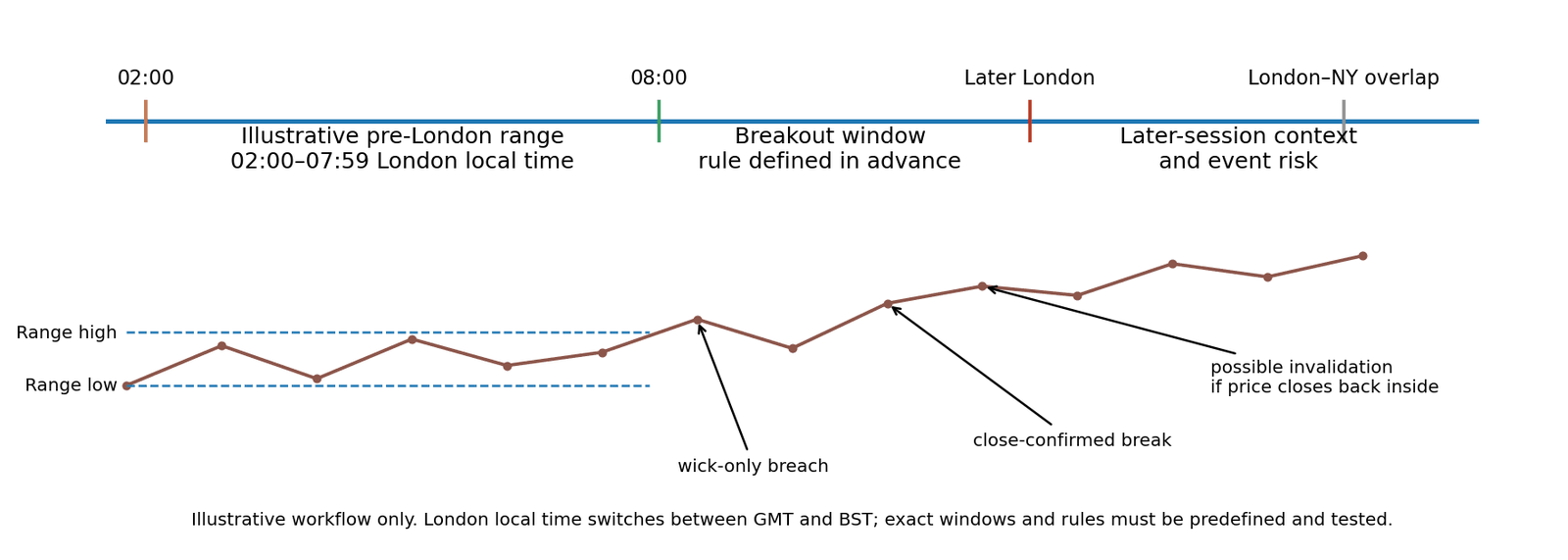
| Range window | Example: 02:00-07:59 London local time | The high, low and width must be drawn from the same predefined window. |
| Breakout window | Defined separately from the range | Prevents the range-building period from being confused with the entry period. |
| Breakout rule | Stop trigger, close, follow-through or retest | Makes false-breakout handling reproducible rather than retrospective. |
Mark the highest high and lowest low formed inside the chosen range window and calculate the width. Do not redraw the range after the breakout is visible. If the method filters unusually wide or narrow ranges, the threshold should come from documented testing rather than an arbitrary pip rule.
What time is the London forex session?
Spot FX is an over-the-counter, decentralised market rather than a single central exchange with one opening bell. For analysis, many UK-facing session guides use roughly 08:00 to 17:00 London local time as the London business-session convention. That convention is separate from the strategy’s own breakout window.
GMT vs BST
London local time is GMT in winter and BST (UTC+1) in summer. In 2026, the UK moved to BST on 29 March and returns to GMT on 25 October. A chart shown in UTC or broker-server time therefore needs an explicit conversion.
The London-New York overlap also shifts relative to UTC when the UK and US change clocks on different dates. Static timing tables can therefore be misleading around daylight-saving transition weeks.
A practical London breakout workflow
- Choose the pair, chart timeframe, London-local reference and exact pre-London range window.
- Mark the range high, range low and range width before the breakout window begins.
- Check scheduled UK/euro-area news plus current spread and volatility conditions.
- Define what counts as a valid breakout: stop trigger, candle close, follow-through or close-and-retest.
- Define invalidation and maximum monetary risk before entry.
- Choose an exit method that can be tested, such as fixed R, range multiple, next structure or a time-based rule.
- Stop applying the setup after the predefined cutoff, invalidation event or major regime change.
- Record fills, spread, slippage and the result for review instead of judging the strategy from isolated examples.
What counts as a valid breakout?
| Entry family | Trigger | Potential benefit | Main trade-off / fill risk |
|---|---|---|---|
| Pending stop | Order triggers as price reaches/passes the boundary | Earlier participation | More exposed to spikes, spread expansion and slippage. |
| Close confirmation | A defined candle closes beyond the boundary | Filters some intrabar breaches | Later entry; larger distance from the boundary is possible. |
| Retest entry | Price breaks, then revisits and holds the boundary under a predefined rule | Can improve structural clarity | Some breakouts never retest, so the setup can be missed. |
A wick beyond the range, a touch beyond it and a close beyond it are different events. This article uses close-based confirmation in the worked example, but that is an illustrative convention, not a claim that close confirmation is universally superior.
GBP and EUR pairs during the London session
| Pair | Why traders may watch it | What can break the assumption |
|---|---|---|
| GBP/USD | Direct GBP exposure during UK hours; deep liquidity | US data, broad USD moves, spreads or risk sentiment can dominate. |
| EUR/USD | European participation and frequent scheduled euro-area/US catalysts | DXY, US rates or euro-specific policy/data may drive the move. |
| EUR/GBP | Direct relative pricing of EUR and GBP | Cross-specific policy divergence and thin-event periods can alter behaviour. |
No pair is permanently the “best” London-breakout market. Pair choice should be frozen in the test specification rather than changed after seeing which chart produced the cleanest breakout that day.
False breakouts and whipsaw around the London open
| Observed event | Close behaviour | Follow-through | Range status under a close-based convention |
|---|---|---|---|
| Brief wick outside range | Closes back inside | None | Range may remain valid; not proof of a liquidity grab. |
| Close outside, immediate reversal | One close beyond | Fails quickly | Failed breakout; strategy-specific invalidation decides next step. |
| Close outside + sustained hold | Close beyond | Additional close/new swing/retest holds | Prior range is increasingly likely to be invalid under the stated rule. |
False breakouts cannot be eliminated. Close confirmation, follow-through, retest rules, range-width filters and no-trade news windows are all testable filters, but each changes trade frequency, timing and execution.
Stop-loss rules for a London breakout setup
| Stop basis | Typical rationale | Trade-off |
|---|---|---|
| Opposite side of range | The original range fully defines structural failure | Can create a large stop distance on wide ranges. |
| Breakout candle / local structure | Keeps invalidation closer to the breakout event | Can be vulnerable to normal post-break noise. |
| Volatility-adjusted distance | Adapts the stop distance to recent movement | Requires a documented volatility rule and still cannot prevent slippage. |
Position size should be derived from the chosen stop distance and maximum monetary risk. A stop price is not a guaranteed fill price during fast movement or gaps.
Take-profit and exit approaches
| Exit family | What it tests | Limitation |
|---|---|---|
| Fixed R multiple | Whether a fixed relationship to initial risk is viable | Ignores changing market structure unless combined with another rule. |
| Range fraction / multiple | Whether the pre-London range can structure target distance | A measured distance is not a promise that price will travel that far. |
| Next structure | Uses visible price levels as exit references | Levels are subjective unless the selection rule is defined. |
| Time-based / trailing | Keeps the trade aligned with session scope or ongoing movement | May exit early or allow give-back; rules must be modelled consistently. |
Scheduled news and session overlap risk
UK CPI, GDP, labour data, PMI and Bank of England events can materially alter GBP volatility during European hours. Euro-area releases can affect EUR pairs, while later US data can dominate EUR/USD and GBP/USD. A news filter should specify which calendar source is used and whether new trades are blocked for a defined period before or after the event.
- Check the event calendar before the range is finalised, not seconds before entry.
- Record whether the setup was traded through a scheduled event or excluded by rule.
- Do not treat the London-New York overlap as automatically producing cleaner continuation.
When not to use the London breakout setup
- The pre-London range is unusually wide under the tested rules, or price has already made a large directional move before the breakout window.
- The range is so narrow that normal spread and price noise dominate the setup.
- A major scheduled event falls inside the entry window and the tested method excludes such conditions.
- Holiday or market-closure conditions materially change liquidity.
- Price repeatedly crosses both boundaries, showing whipsaw rather than sustained acceptance.
- Platform/server timestamps cannot be reconciled with the London-local timing rules.
How to backtest a London breakout strategy properly
| Specification field | What must be frozen |
|---|---|
| Pair and data source | Exact instrument, venue/provider and data quality. |
| Timeframe and timezone | Chart interval plus London-local, UTC and any broker-server conversion rules. |
| Range / breakout windows | Exact start/end times with GMT/BST handling. |
| Entry rule | Stop trigger, candle close, follow-through or retest definition. |
| Stop / exit | All stop, target, trailing and time-cutoff rules. |
| Costs | Spread, commission where relevant and slippage assumptions. |
| News filter | Which events are excluded and the pre/post event window. |
| Validation | Sample size, yearly/regime breakdown, expectancy, drawdown and out-of-sample review. |
Performance claims are only meaningful when the methodology is auditable. Win rate alone is insufficient because average win/loss, transaction costs, drawdown, sample size and rule changes all affect the result.
Worked example: hypothetical GBP/USD London breakout
The following numbers are illustrative and are not a historical or live trade recommendation.
| Input / observation | Illustrative value | Interpretation |
|---|---|---|
| Reference timezone | London local time | UTC offset differs between GMT and BST. |
| Pre-London range | 02:00-07:59 London local | Example rule only; not a universal Asian-session definition. |
| Range low | 1.2720 | Lowest price inside the defined window. |
| Range high | 1.2760 | Highest price inside the defined window. |
| Range width | 40 pips | 1.2760 – 1.2720 = 0.0040 = 40 pips. |
| Breakout rule | 15-minute candle closes above 1.2760 | Close-based confirmation chosen before the event. |
| Entry reference | 1.2772 | Arithmetic reference only; actual fill may differ. |
| Invalidation | 1.2748 | 24-pip gross price risk from the illustrative entry. |
| 2R reference | 1.2820 | 48 pips above 1.2772 = 2 x 24 pips before costs. |
| Failure condition | Close back inside the range under the strategy rule | Shows why an initially confirmed breakout can still fail. |
The lesson is reproducibility: range window, timezone, boundary, confirmation and invalidation are fixed before the result is visible. The 2R line is a risk/reward illustration, not a forecast or required take-profit. A stop-entry or retest-entry variant could produce a different result from the same price sequence.
Turn Trading Calculations Into Real Trading Decisions
Use your calculated risk levels, position sizing, and technical analysis together with live forex trading signals and market commentary from The Forex Complex.

Frequently asked questions
What is the London breakout strategy?
It is a family of session-based breakout methods that define a pre-London range and then apply a predefined rule for a later break beyond the range. Exact hours, confirmation, stop and exit rules vary and should be tested as one complete ruleset.
What time is the London forex open in the UK?
For session analysis, London is commonly referenced from about 08:00 London local time, but spot FX has no central opening bell. London local time is GMT in winter and BST in summer, so UTC and broker-server labels must be converted correctly.
What is the Asian range in forex?
It is a trader-defined high-low window during Asian or pre-London hours. There is no universal range window, so the exact start/end times and timezone must be stated.
Which pairs are best for the London breakout strategy?
There is no permanent best pair. GBP/USD, EUR/USD and EUR/GBP are commonly watched examples, but pair choice should be part of the tested specification rather than a fixed ranking.
How can traders avoid false breakouts at the London open?
They cannot eliminate them. Close confirmation, follow-through, retest, volatility and news filters can be tested, but each introduces trade-offs and none guarantees continuation.
Where should a stop loss go on a London breakout?
Common frameworks use the opposite side of the range, breakout structure or a volatility-adjusted distance. No fixed pip distance is universally appropriate, and live stop fills may differ from the requested stop price.
Key takeaway
A London breakout strategy is only testable when its session window, timezone, breakout rule, invalidation, risk and exit logic are fixed in advance. UK clock changes, scheduled news, spread and slippage all matter. The session label provides context; it does not guarantee direction or follow-through.




 Join Our Free Group

 Twitter