

In this article (11 sections)
- What does “forex trader” mean in a UK career context?
- How much do FX traders earn in the UK?
- Base salary vs bonus: how trader compensation actually works
- How pay differs by career path
- Why London FX trader pay can vary so much
- Entry-level to senior FX trading career path
- What qualifications do UK FX traders need?
- Retail forex trading income is not a salary
- How to read forex trader salary data without being misled
- Worked example: comparing two hypothetical offers
- Frequently asked questions
There is no single “forex trader salary” in the UK. Professional FX traders work across bank desks, hedge funds, proprietary or market-making firms and execution teams, and pay usually combines a base salary with variable compensation. Current London salary sources show wide ranges, but they measure different roles and small samples. Retail trading profits are different again: they are not an employment salary and can be negative as well as positive.
What does “forex trader” mean in a UK career context?
The same phrase can describe very different economic models. Before comparing pay, separate salaried institutional work from self-directed trading and retail funded-account programmes.
| Role | Economic model | How compensation works | Main distinction |
|---|---|---|---|
| Bank FX trader | Employee on a bank markets desk | Base salary + variable bonus + benefits | Professional employment; role may involve pricing, risk, client flow or execution. |
| Hedge fund / macro trader | Employee or partner at an investment firm | Base + performance-linked bonus; sometimes profit participation | Compensation can be highly performance-sensitive and skewed at senior levels. |
| Employed prop / market-making trader | Employee of a trading firm | Base + performance bonus / profit-related component | Not the same as a retail “funded account” customer. |
| FX execution / treasury role | Employee handling execution or liquidity | Salary + bonus / benefits depending on employer | Usually less direct P&L ownership than a risk-taking desk. |
| Retail self-directed trader | Uses personal capital | Trading P&L only | No employer salary; income can be irregular or negative. |
| Retail prop participant | Contract participant in a funded-account programme | Contractual payouts under programme rules | A payout is not an institutional employment salary. |
How much do FX traders earn in the UK?
The most defensible answer is a range of evidence types rather than one blended “average”. London dominates UK institutional FX hiring, and seniority, desk type and employer model can move compensation dramatically.
| Source | Population / role | Current figure | What it tells you | Caveat |
|---|---|---|---|---|
| Glassdoor | FX Trader, London | £45k-£110k base; £71k average base | A current crowdsourced London FX-trader snapshot | Crowdsourced and sample-limited; not an official market rate. |
| National Careers Service | Stockbroker, UK | £35k starter to £125k experienced | Broad UK financial-markets career context | Related occupation, not an FX-specific benchmark. |
| Live finance vacancies | London trader / FX roles | Varies materially by title and seniority | Shows actual advertised role-by-role compensation | Job ads are volatile and cannot be averaged across unlike roles. |
Checked: 29 September 2026. Glassdoor currently displays a £45,000-£110,000 base-pay range and £71,000 average base for “FX Trader” in London. The National Careers Service lists £35,000 starter to £125,000 experienced for stockbrokers as broader market-career context. eFinancialCareers trader vacancies in London provide role-by-role vacancy context but change frequently. These sources should not be merged into one FX salary average.
Base salary vs bonus: how trader compensation actually works
| Component | Fixed or variable? | What drives it | Can it fall to zero? |
|---|---|---|---|
| Base salary | Fixed contractual cash compensation | Role, seniority, firm, location, responsibilities | Not normally, while employed under the contract. |
| Discretionary / performance bonus | Variable | Individual, desk and firm performance; risk and conduct factors | Yes. |
| Profit share / performance allocation | Variable | Strategy or desk economics under the firm’s formula | Potentially. |
| Benefits / deferred compensation | Mixed | Employer policy, seniority and regulation | Depends on the component and vesting terms. |
A lower base can coexist with higher upside, while a high headline bonus is never guaranteed. In regulated firms, variable compensation may also be deferred, subject to vesting or clawback, so “total compensation” is not necessarily the same as immediate cash pay.
How pay differs by career path
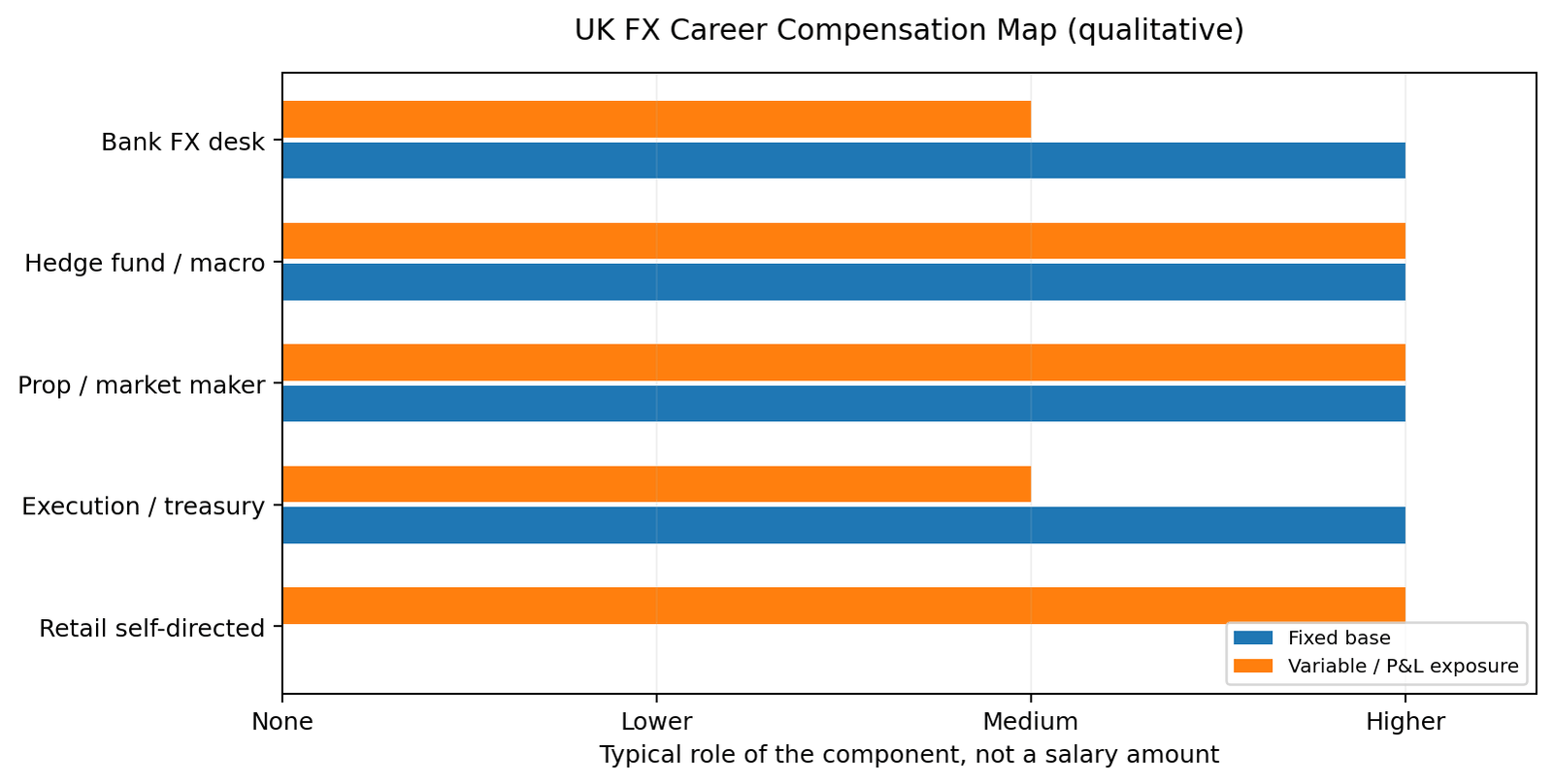
| Career path | Typical structure | Main pay drivers | Key caveat |
|---|---|---|---|
| Bank FX desk | Base + discretionary / performance bonus | Seniority, desk revenue, client flow, product, firm results | Public datasets may mix trading, sales and support roles. |
| Hedge fund / macro | Base + performance-linked bonus; sometimes profit participation | Fund results, individual contribution, mandate and risk | Top-end pay is highly skewed by a small number of senior performers. |
| Prop / market maker | Base + performance / profit-related component | Risk-adjusted results, strategy, firm model | Do not confuse employed traders with retail prop customers. |
| Execution / treasury | Salary + bonus / benefits | Execution responsibility, liquidity management, experience | Title alone may not reveal direct P&L ownership. |
| Retail self-directed | No salary; P&L only | Capital, returns, drawdowns and costs | Can be negative and irregular. |
Why London FX trader pay can vary so much
- Experience and seniority: graduate or analyst roles should not share one benchmark with senior traders or desk heads.
- Desk type: spot, forwards, options, electronic execution, systematic and macro mandates can require different skills and carry different P&L responsibility.
- Risk and revenue ownership: direct risk-taking differs from execution or support responsibility.
- Employer type: banks, hedge funds, market makers and fintech or payments firms use different compensation structures.
- Market cycle and firm profitability: bonus pools can change even when base salary does not.
- Location: London is the main UK institutional FX centre, so UK-wide figures can distort London-specific roles.
Entry-level to senior FX trading career path
| Stage | Typical responsibilities | What often changes with progression |
|---|---|---|
| Graduate / analyst | Market monitoring, data work, trade support, execution assistance, risk checks | Product knowledge, judgement, desk trust and technical capability. |
| Associate / junior trader | More direct execution, risk monitoring and defined trading responsibility | Greater autonomy and accountability. |
| VP / senior trader | Material risk, client/product responsibility, strategy ownership | Larger mandate and more variable compensation exposure. |
| Desk lead / head | People, risk, governance, revenue and strategy oversight | Leadership and firm-level accountability. |
Titles are not standardised across firms. Quantitative and electronic FX roles may require stronger mathematics, statistics and programming skills than discretionary or client-flow roles, and progression is never automatic.
What qualifications do UK FX traders need?
Many employers recruit from finance, economics, mathematics, engineering, computer science and related degrees, but there is no single degree that is legally required for every FX trader role. Apprenticeships, graduate schemes and direct-entry routes also exist in financial services. For regulated roles, the FCA Certification Regime may apply depending on the firm and the function performed.
| Area | How to interpret it |
|---|---|
| Degree / academic route | Common in institutional hiring, especially finance, economics, maths, engineering and computer science, but employer requirements vary. |
| CFA / CISI and other professional study | Can support some paths, but neither is a universal guarantee or requirement for every FX trader job. |
| Quantitative / programming skills | Especially relevant to electronic, systematic and algorithmic trading roles. |
| FCA Certification Regime | Current FCA material includes proprietary trader, client-dealing and algorithmic-trading functions among certification functions where applicable. |
| Competence / fit and proper | Authorised firms are responsible for assessing relevant staff and maintaining applicable competence and certification processes. |
Key point: A qualification can strengthen a candidate profile, but it does not guarantee a trading role. Regulatory applicability depends on the firm and the function actually performed.
Retail forex trading income is not a salary
| Feature | Employed trader | Retail trader | Retail prop participant |
|---|---|---|---|
| Income source | Employer payroll | Market P&L | Programme payout / reward |
| Fixed base | Usually yes | No | Usually no |
| Variable component | Bonus / performance pay | Trading gains or losses | Eligible payout under programme rules |
| Can income be negative? | Base salary itself is contractual; bonus may be zero | Yes, trading losses can exceed gains | Payout may be zero; fees/costs may still apply |
| Best comparison | Employment compensation | Investment/trading result | Contractual programme economics |
Do not annualise a short run of profitable retail months into a “salary”. Retail forex trading P&L is variable, can be negative, and has no employer-funded base pay. A funded-account payout is also contractual programme income, not the same thing as compensation on an institutional trading desk.
How to read forex trader salary data without being misled
- Check whether the figure is base pay, bonus, or total compensation.
- Check the exact role and seniority; FX trader, sales trader, trade support, quant researcher and head of FX are not interchangeable.
- Check location and date; London and UK-wide data can differ materially.
- Check source type and sample quality: crowdsourced salary site, job advertisement, recruiter survey or official career profile.
- Use more than one evidence type before describing a range, and do not convert an exceptional senior package into a typical salary.
Worked example: comparing two hypothetical offers
The following figures are illustrative only. They show why base salary and total compensation should be separated rather than treated as the same thing.
| Item | Offer A: bank FX role | Offer B: performance-heavy trading firm |
|---|---|---|
| Base salary | £70,000 | £55,000 |
| Illustrative bonus rule | 20% of base if awarded | 0%-100% of base depending on performance |
| Illustrative total if stated bonus is paid | £84,000 | £55,000-£110,000 |
| What is guaranteed by the example? | Only the £70,000 base before tax / contract conditions | Only the £55,000 base before tax / contract conditions |
| Main lesson | Higher base gives more predictable cash compensation | Wider variable component can create higher upside and lower predictability |
Offer B is not automatically “better paid” because the upside depends on an unknown performance outcome. Real bonus plans can also include thresholds, deferral, clawback or other conditions. No expected bonus should be assigned without evidence.
Turn Trading Calculations Into Real Trading Decisions
Use your calculated risk levels, position sizing, and technical analysis together with live forex trading signals and market commentary from The Forex Complex.

Frequently asked questions
How much do forex traders earn in the UK?
There is no single UK figure. Pay varies by employer, role, seniority and location. Current London evidence should be shown with source and date, with base salary separated from bonus and total compensation.
What is the average FX trader salary in London?
Glassdoor currently shows a £71,000 average base and a £45,000-£110,000 base range for FX Trader in London, checked 29 September 2026. It is crowdsourced and should not be treated as an official market rate.
Do professional forex traders get a salary?
Employed institutional traders normally receive a contractual base salary and may receive variable compensation. Retail traders do not receive a salary from the market.
How much can a forex trader earn from bonuses?
There is no universal percentage. Bonus structures vary by employer, desk, seniority and performance and may be discretionary or subject to deferral and clawback.
Do you need a degree to become an FX trader in the UK?
A relevant degree is common in institutional hiring, but routes vary and apprenticeships or other direct-entry paths can exist. No single credential guarantees a role.
Is retail forex trading income the same as a trader salary?
No. Retail trading income is market P&L and can be negative. Salary is contractual compensation paid by an employer.




 Join Our Free Group

 Twitter