

In this article (11 sections)
- What is a forex economic calendar?
- How to read actual, forecast and previous
- Which UK economic events matter most for forex traders?
- Why NFP matters to UK forex traders
- How to use an economic calendar today and this week
- How high-impact news can affect spread, slippage and volatility
- Why better than forecast does not always mean currency up
- A practical pre-event forex calendar workflow
- Worked example: hypothetical UK CPI release
- Choosing an economic calendar source
- Frequently asked questions
A forex economic calendar lists scheduled macroeconomic releases and policy events that can change market expectations, such as Bank of England decisions, UK CPI, GDP, employment data, PMI and US Nonfarm Payrolls. UK traders can use it to plan around event risk, compare actual data with forecasts and previous readings, and prepare for volatility. The calendar does not predict the direction or size of the market reaction.
What is a forex economic calendar?
An economic calendar organises scheduled data releases, central-bank decisions and other macro events by date and time. Most forex calendars show the affected country or currency, the event name, a provider-defined impact label and fields for previous, forecast and actual values. It is best used as a planning and interpretation tool rather than a prediction engine.
| Field | Meaning | What to verify | Common mistake |
|---|---|---|---|
| Time | Scheduled publication time | Timezone and daylight-saving setting | Assuming GMT applies year-round in the UK |
| Currency / country | Market most directly linked to the event | Whether the pair also has exposure to another currency | Treating a UK event as relevant only to GBP pairs |
| Previous | Earlier published reading | Whether it was revised | Comparing against an obsolete previous value |
| Forecast / consensus | Pre-release estimate | Provider methodology and timestamp | Treating consensus as what every trader expected |
| Actual | Newly published result | Primary source and revision details | Assuming a surprise fixes the market direction |
| Impact | Provider risk/volatility classification | Provider methodology | Treating “high impact” as an official guarantee |
How to read actual, forecast and previous
Previous is the earlier reported value, forecast or consensus is the estimate available before the release, and actual is the newly published figure. The simplest “surprise” is the difference between actual and forecast, but that is only the start of interpretation. Previous values may be revised, subcomponents can conflict, and positioning can make a seemingly strong number produce a muted or opposite price reaction.
| Previous | Forecast | Actual | Immediate read | Important caveat |
|---|---|---|---|---|
| 2.6% | 2.7% | 3.0% | Headline is 0.3 percentage points above consensus | Check revisions, components and policy expectations |
| 2.6% revised to 2.5% | 2.7% | 3.0% | Current reading also rises more versus revised previous | A larger data change still does not guarantee GBP direction |
Which UK economic events matter most for forex traders?
For a UK-focused calendar, the highest-value recurring events are Bank of England policy decisions and major data releases from the Office for National Statistics, alongside S&P Global UK PMI surveys. Their importance varies with the market regime, because an event matters most when it changes expectations about growth, inflation or monetary policy.
| Event | Primary source | What it measures | Why FX traders watch it | Key caveat |
|---|---|---|---|---|
| BoE MPC decision | Bank of England | Bank Rate, vote split and policy guidance | Can reprice UK rate expectations and sterling | An unchanged rate can still move GBP if guidance or votes surprise |
| UK CPI / CPIH | ONS | Consumer-price inflation | Shapes inflation and policy expectations | Headline and underlying components can point in different directions |
| GDP | ONS | Monthly output and quarterly growth | Updates the growth outlook | Early estimates are revised and horizons differ |
| Labour market | ONS | Employment, unemployment and earnings | Wages and slack influence policy expectations | Multiple measures and revisions can complicate the signal |
| UK PMI | S&P Global Market Intelligence | Survey-based business activity | Provides timely activity and price-pressure context | Survey data are not the same as official GDP |
Bank of England decisions: read more than the rate
A Bank of England decision should be read as a package: the Bank Rate decision, MPC vote split, policy statement and, on Monetary Policy Report dates, updated forecasts and policy discussion. The Bank’s 2026 schedule lists MPC announcements for 5 November and 17 December after the September meeting. These dates are time-sensitive and should be rechecked before publication or use.
- Decision: was Bank Rate changed or maintained?
- Votes: did the MPC split shift relative to expectations?
- Communication: did the language change the expected policy path?
- Forecasts: on Monetary Policy Report dates, did growth or inflation projections move materially?
- Market reaction: did sterling sustain the initial move or reverse after the first repricing?
UK CPI, GDP, employment and PMI
UK CPI is watched because inflation influences expectations for monetary policy. GDP releases update the growth picture, while labour data combine employment, unemployment and earnings. PMI surveys provide a timely survey-based view of business activity and price pressures. These series should be interpreted together rather than as isolated “good” or “bad” numbers.
Why NFP matters to UK forex traders
Nonfarm Payrolls is a US release within the Bureau of Labor Statistics Employment Situation report. It matters to UK forex traders because a repricing of US growth, labour conditions and Federal Reserve expectations can move the US dollar and therefore GBP/USD. The Employment Situation schedule is published in US Eastern Time, so UK traders should verify the London-time conversion, especially around the weeks when US and UK daylight-saving changes do not coincide.
| Component | What it adds | Why the headline alone can mislead |
|---|---|---|
| Payrolls | Change in nonfarm employment | A strong payroll number can be offset by other details |
| Unemployment rate | Labour-market slack | Can move in a different direction from payrolls |
| Average hourly earnings | Wage pressure | Can change inflation and policy interpretation |
How to use an economic calendar today and this week
1. Confirm the calendar timezone first. In the UK, check whether times are displayed in local time, GMT, BST or UTC.
2. Review the full week before the trading day so major events are not discovered minutes before release.
3. Filter to the currencies and pairs you actually trade, then note events affecting both sides of the pair.
4. Flag clusters of releases, central-bank events and overlapping catalysts rather than viewing each event in isolation.
5. Set alerts or a pre-event checklist and verify important dates/times against primary sources.
6. After the release, record actual values, revisions, immediate movement and later follow-through.
How high-impact news can affect spread, slippage and volatility
| Market condition | Possible execution effect | What a trader can control | What cannot be guaranteed |
|---|---|---|---|
| Before release | Liquidity may thin; spreads may widen | Exposure, order type, event window, size | Normal spread conditions |
| At release | Quotes may change rapidly; market/stop fills can slip | Maximum risk and whether to participate | Exact fill at observed quote/trigger |
| Immediately after | Volatility can remain elevated or reverse sharply | Wait for conditions to stabilise if that fits the plan | Direction or persistence of the first move |
Execution reminder
A “high-impact” label is usually a calendar-provider classification. It is not an official guarantee that volatility will be large, and tighter execution controls can introduce rejection or missed-fill risk rather than eliminating slippage.
Why better than forecast does not always mean currency up
Markets reprice relative to expectations, but the published consensus is only one estimate of what participants expected. A stronger-than-forecast release can still coincide with currency weakness if the result was already priced in, revisions weaken the message, another component disappoints, positioning unwinds, or the central-bank reaction function points elsewhere.
| Myth | Reality |
|---|---|
| Better data = currency must rise | The surprise can already be priced in or offset by revisions and positioning. |
| The first tick shows the “true” interpretation | Initial moves can reverse as liquidity normalises and traders digest details. |
| High-impact means a large move | Impact labels are provider-specific classifications, not official volatility guarantees. |
A practical pre-event forex calendar workflow
1. Identify the event, primary source, exact release time and affected currency.
2. Record previous, forecast and any likely revision or multi-component risk.
3. Check current market structure and whether another catalyst is already driving the pair.
4. Decide before the event whether to avoid new exposure, reduce size, widen a no-trade window or simply observe.
5. If trading through the event, define maximum risk and accept that stop execution can be worse than planned in fast markets.
6. After release, log the actual figure, revisions, immediate move and later follow-through before drawing conclusions.
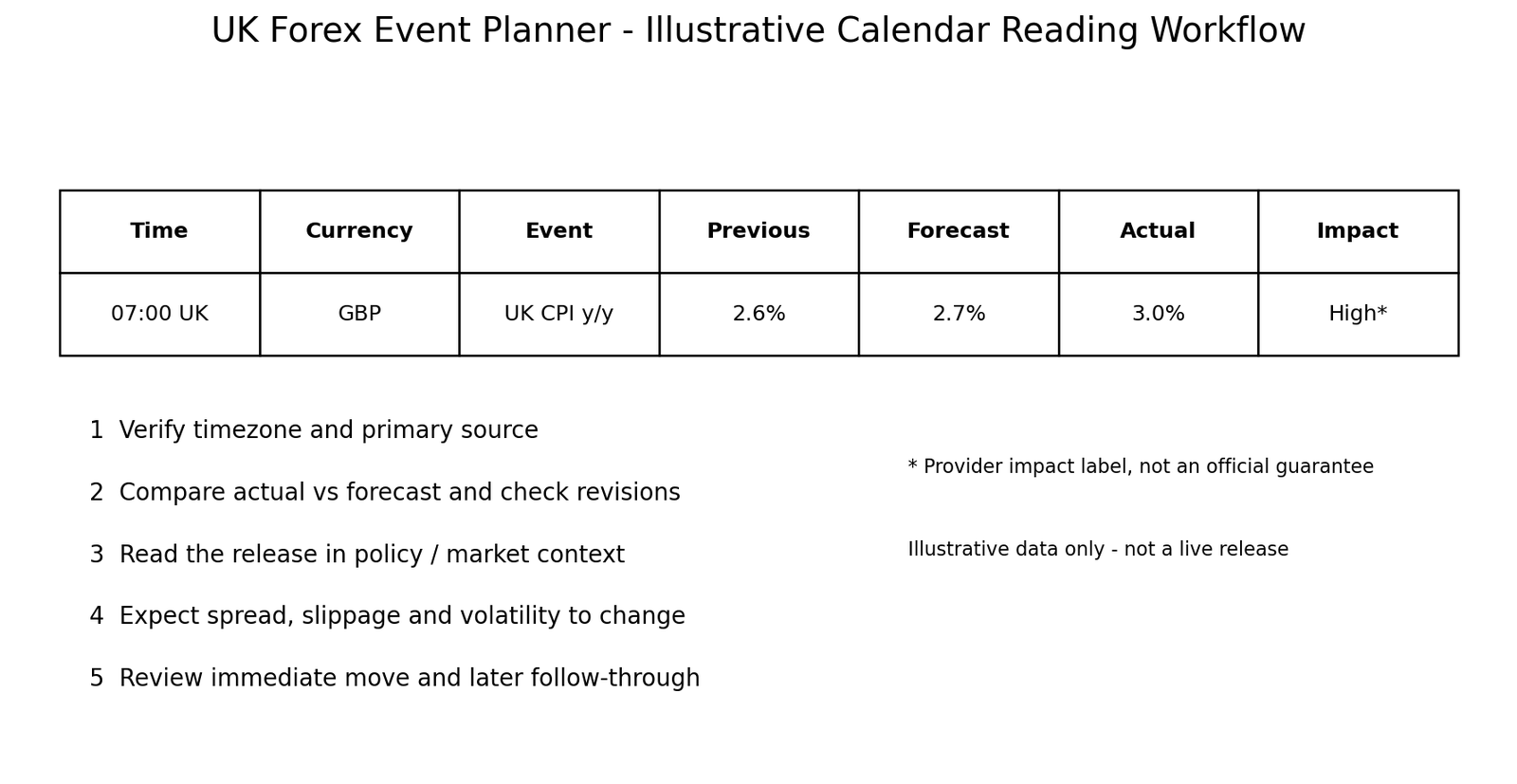
Worked example: hypothetical UK CPI release
Assume a UK CPI release shows the following illustrative values for GBP/USD: previous 2.6% year on year, consensus 2.7%, actual 3.0%, with the previous reading revised to 2.5%.
| Input | Illustrative value |
|---|---|
| Previous UK CPI y/y | 2.6% |
| Consensus forecast | 2.7% |
| Actual release | 3.0% |
| Previous revised to | 2.5% |
| Observed pair | GBP/USD |
| Impact label | High impact – provider label |
The headline actual is 0.3 percentage points above consensus. The downward revision to the previous value means the change from the revised prior reading is larger than a simple 3.0% versus 2.6% comparison would suggest. A stronger-than-expected inflation reading may increase expectations for tighter Bank of England policy relative to the prior market view, which can support sterling, but this is a conditional interpretation rather than a forecast.
Limitation
The initial price move can reverse. Consensus values can change before release, spreads can widen and fills can slip. The example does not imply that a 0.3 percentage-point surprise has a standard or predictable GBP/USD effect.
Choosing an economic calendar source
Choose a calendar that makes timezone handling, source attribution, previous/forecast/actual values and revisions clear. For important UK events, verify the source data against the Bank of England, ONS or S&P Global. For US employment, verify against BLS. Third-party providers can be useful interfaces, but their impact labels and consensus datasets are provider-specific rather than official statistical classifications.
Turn Trading Calculations Into Real Trading Decisions
Use your calculated risk levels, position sizing, and technical analysis together with live forex trading signals and market commentary from The Forex Complex.

Frequently asked questions
What is the best economic calendar for forex trading?
There is no universal best calendar. Prioritise clear timezone handling, previous/forecast/actual fields, transparent sourcing and reliable updates, then verify important UK releases against primary sources.
What does “forecast” mean on an economic calendar?
Forecast usually means a pre-release consensus estimate collected from economists or market participants. The methodology and sample can differ by provider.
Why can a currency fall after better-than-expected data?
The result may already be priced in, revisions or other components may weaken the message, positioning may unwind, or policy expectations may react differently than the headline implies.
What UK economic releases can move GBP?
Bank of England decisions, CPI, GDP, labour-market data and PMI are commonly watched. Their market impact varies with expectations and the broader policy backdrop.
What time are UK economic releases published?
Release times vary by source and event. Many ONS releases are scheduled for 07:00 UK time, but the official calendar should be checked because not every release uses the same time and the UK switches between GMT and BST.
How should traders use an economic calendar this week?
Review the whole week first, filter for currencies you trade, note event clusters, confirm timezones and decide the risk/exposure plan before each release rather than minutes before it.




 Join Our Free Group

 Twitter