
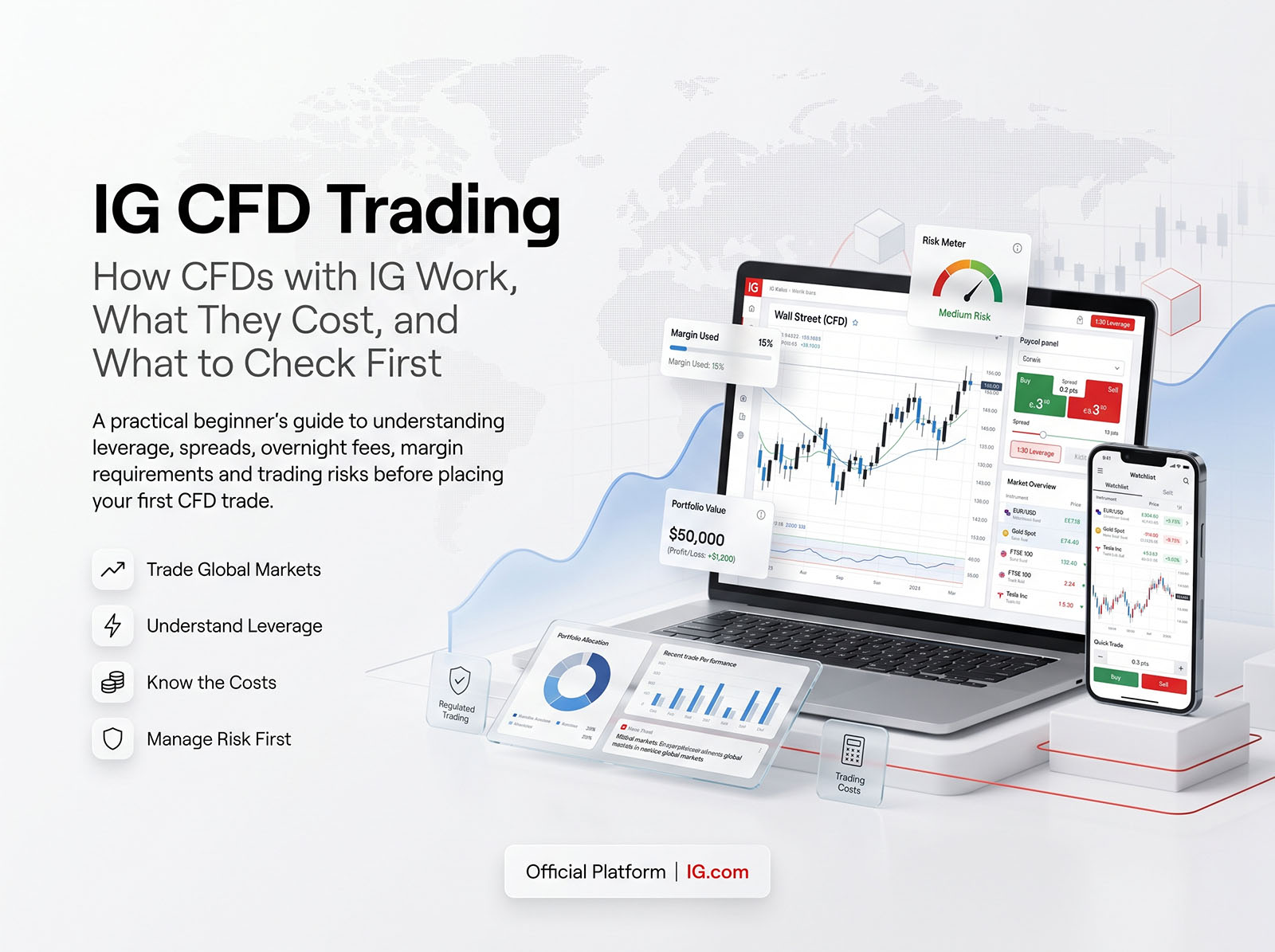
In this article (21 sections)
- Key Takeaways
- What Is IG CFD Trading?
- IG CFD vs Buying the Underlying Asset
- How IG Markets CFD Trading Works
- What Markets Can You Trade as IG CFDs?
- IG CFD Charges, Fees and Trading Costs
- IG CFD Fees by Market Type
- IG CFD Margin and Leverage Explained
- Risks of Trading CFDs with IG
- Stop-Loss Orders, Guaranteed Stops and Slippage
- Demo Account vs Live IG CFD Account
- IG CFD Trading Platforms and Tools
- IG Academy and CFD Education
- Building an IG CFD Trading Plan
- Market Analysis for IG CFD Traders
- Position Sizing for IG CFD Trading
- Common Mistakes When Trading CFDs with IG
- IG CFD Trading Costs Checklist
- When IG CFD Trading May Not Be Suitable
- Final Thoughts
- Frequently Asked Questions
Key Takeaways
- IG CFD trading lets users speculate on market price movements without owning the underlying asset.
- CFDs are leveraged products, so both profits and losses are calculated on the full position size, not only the margin deposit.
- IG CFD charges can include spreads, commissions, overnight funding, currency conversion, guaranteed stop premiums and other account-related costs.
- IG CFD margin requirements vary by market, position size and account type, so margin should always be checked before opening a trade.
- IG provides trading platforms, charts, alerts, demo accounts and educational resources, but trading decisions remain the user’s responsibility.
- Stop-loss orders can help manage risk, but they do not remove risk completely because slippage can occur in fast or gapping markets.
- A demo account can help users practise, but it does not fully recreate the pressure, execution and funding conditions of live CFD trading.
What Is IG CFD Trading?
IG CFD trading is the process of trading contracts for difference through IG’s trading platform.
A CFD, or contract for difference, is a derivative product. Instead of buying the underlying asset, you trade on whether its price will rise or fall. The profit or loss is based on the difference between the opening price and closing price of the CFD position.
For example:
- If you think a market will rise, you can open a long CFD position.
- If you think a market will fall, you can open a short CFD position.
- If the market moves in your favour, the trade may make a profit.
- If the market moves against you, the trade may make a loss.
The important point is that you do not own the underlying market. You are trading exposure to price movement.
This can make CFDs flexible, but it also makes them risky, especially because CFDs are usually traded with leverage.
IG CFD vs Buying the Underlying Asset
CFD trading is different from traditional investing.
When you buy a share outright, you own the share. When you trade a share CFD, you do not own the share. You are speculating on the price movement of that share.
| Feature | Buying the underlying asset | Trading a CFD |
|---|---|---|
| Ownership | You own the asset | You do not own the asset |
| Direction | Usually profit if price rises | Can go long or short |
| Leverage | Usually unleveraged unless borrowing is used | Commonly leveraged |
| Holding cost | May include custody, platform or tax considerations | May include overnight funding |
| Risk | Asset can fall in value | Losses can be magnified by leverage |
| Use case | Longer-term ownership or investment | Shorter-term speculation or hedging |
CFDs can be useful for traders who want flexible exposure, but they are not automatically better than investing. They are complex and require careful risk management.
How IG Markets CFD Trading Works
IG provides the trading platform, account infrastructure and market access for CFD trading. The user decides what to trade, when to enter, when to exit and how much risk to take.
A typical IG CFD trade works like this:
- Open or log in to an IG CFD account.
- Choose a market.
- Decide whether to go long or short.
- Check the spread, commission, margin and overnight funding.
- Set trade size.
- Add a stop-loss, limit order or guaranteed stop where appropriate.
- Open the position.
- Monitor the trade.
- Close the position manually or through an order.
IG acts as an execution-only provider. That means the platform can provide tools, prices, execution and education, but it does not make personal trading decisions for you.
What Markets Can You Trade as IG CFDs?
IG offers CFD access to many market types. Exact availability can change by region, account type and product rules.
Common CFD market categories include:
- forex
- indices
- shares
- commodities
- ETFs
- bonds or rates
- sectors
- options or other derivative-style markets, where available
Do not assume every market is available to every account. Always check the current IG product details, trading hours, margin requirements and costs before placing a trade.
A beginner does not need to trade every available market. It is usually safer to start with a small number of markets and understand how they behave.
IG CFD Charges, Fees and Trading Costs
IG CFD trading costs can include several components. The full cost is not always visible from the headline spread alone.
Common IG CFD charges to check include:
| Cost type | What it means |
|---|---|
| Spread | Difference between the buy and sell price |
| Commission | Separate dealing charge on some CFD markets |
| Overnight funding | Cost or credit for holding leveraged positions overnight |
| Currency conversion | Cost if account currency and market currency differ |
| Guaranteed stop premium | Possible charge if a guaranteed stop is triggered |
| Market data fees | Possible fee for certain live data feeds |
| Inactivity or account fees | Possible account-related costs depending on terms |
Before trading, review the current charges for the exact market and account type.
IG CFD Fees by Market Type
Different CFD markets can have different fee structures.
| CFD market | Cost points to check |
|---|---|
| Forex CFDs | Spread, overnight funding, margin, currency conversion |
| Index CFDs | Spread, overnight funding, trading hours |
| Share CFDs | Commission, market data, overnight funding, currency conversion |
| Commodity CFDs | Spread, overnight funding, contract pricing method |
| ETF CFDs | Commission or spread, overnight funding, market data |
| Crypto-related products, where available | Product availability, spread, fees, restrictions and risk warnings |
The cheapest-looking market is not always the lowest-risk market. Volatility, leverage, spread widening and overnight costs can matter more than the initial quoted spread.
IG CFD Margin and Leverage Explained
Margin is the amount of money required to open and maintain a leveraged CFD position.
Leverage lets you control a larger market exposure with a smaller deposit. This can increase potential profit, but it also increases potential loss.
For example, if a CFD position has a 5% margin requirement, you may only need to deposit 5% of the full exposure to open the position. But profit and loss are still based on the full position size.
This is why margin should not be treated as the amount you can lose. Losses can be much larger than the margin required to open the trade, especially if the market moves sharply.
Before opening an IG CFD trade, check:
- margin requirement
- total position value
- pip or point value
- stop-loss distance
- maximum acceptable loss
- available account balance
- margin close-out rules
- whether negative balance protection applies
- whether you are retail or professional client
Leverage should be treated as a risk amplifier, not a shortcut.
Risks of Trading CFDs with IG
CFDs are high-risk products because they combine market volatility with leverage.
Main risks include:
- losing money quickly
- losses being magnified by leverage
- margin calls
- positions closing automatically if margin is insufficient
- slippage during fast markets
- overnight funding costs
- spread widening
- emotional overtrading
- trading too large for the account balance
- confusing demo performance with live performance
A trader can be correct about the market direction but still lose money if position sizing, timing, costs or risk controls are poor.
Stop-Loss Orders, Guaranteed Stops and Slippage
Risk-management orders are important in CFD trading, but they need to be understood correctly.
Stop-loss order
A stop-loss order is designed to close a trade if the market reaches a chosen level. It can help limit losses, but it may not execute at the exact stop level if the market gaps or moves quickly.
Guaranteed stop
A guaranteed stop is designed to close the trade at the selected level even if the market gaps. It may involve a premium if triggered, and availability can vary by market.
Limit order
A limit order can close a position at a selected profit level if the market reaches that price.
Alerts
Alerts can notify you when a market reaches a specific level, but they do not close trades by themselves.
Stops and alerts should support a broader trading plan. They are not a replacement for position sizing and risk control.
Demo Account vs Live IG CFD Account
An IG demo account can be useful for learning the platform and practising trade execution without using real money.
A demo account can help you practise:
- opening and closing trades
- using charts
- placing stop-losses
- setting alerts
- testing order tickets
- understanding margin display
- reviewing trade history
- trying different market types
However, demo trading has limits.
It does not fully recreate:
- emotional pressure
- live slippage
- withdrawal process
- real funding decisions
- fear of loss
- overconfidence after wins
- behaviour during volatile live markets
Use the demo account as a learning tool, not as proof that a strategy will work live.
IG CFD Trading Platforms and Tools
IG provides platform tools that can help traders analyse markets and manage positions.
Common tools may include:
- web platform
- mobile trading app
- charts
- technical indicators
- watchlists
- price alerts
- economic calendar
- market news
- order tickets
- stop and limit orders
- account reports
- demo environment
These tools can support trading decisions, but they do not remove the need for a plan.
A charting tool can help identify a setup. It cannot guarantee the trade will work.
IG Academy and CFD Education
IG Academy can be useful for beginners who want to learn the basics of spread betting, CFDs, leverage, margin and trading risk.
Educational resources may include:
- beginner courses
- short lessons
- videos
- quizzes
- practical exercises
- demo-account practice
- market explainers
Education should come before live trading. If a user cannot explain leverage, margin, stop-losses, spreads and overnight funding, they are probably not ready to trade CFDs with real money.
Building an IG CFD Trading Plan
A CFD trading plan gives structure to trading decisions.
A useful plan should define:
- markets to trade
- reasons for entering a trade
- maximum risk per trade
- position sizing method
- stop-loss placement
- profit-taking plan
- maximum daily or weekly loss
- whether overnight positions are allowed
- markets or events to avoid
- review process after trades
The goal is not to win every trade. The goal is to make decisions consistently and control losses when trades do not work.
Market Analysis for IG CFD Traders
CFD traders often use a mix of technical and fundamental analysis.
Technical analysis
Technical analysis studies price charts, patterns and indicators.
Common tools include:
- support and resistance
- moving averages
- trendlines
- RSI
- MACD
- candlestick patterns
- volume, where available
Fundamental analysis
Fundamental analysis looks at economic, financial and market news.
This may include:
- interest rate decisions
- inflation data
- employment reports
- company earnings
- commodity supply and demand
- geopolitical events
- central bank statements
A trader might use fundamental analysis to decide what market to watch and technical analysis to decide when to enter or exit.
Position Sizing for IG CFD Trading
Position sizing is one of the most important parts of risk management.
A simple risk process:
- Decide how much of the account you are willing to risk.
- Choose a stop-loss level based on market structure.
- Calculate the distance between entry and stop.
- Work out the trade size that matches your risk limit.
- Check margin requirement before opening the trade.
Do not choose position size only because the margin requirement looks affordable.
The margin deposit is not the same as the potential loss.
Common Mistakes When Trading CFDs with IG
Avoid these mistakes:
- trading without a plan
- using too much leverage
- treating margin as maximum loss
- ignoring overnight funding
- trading too many markets at once
- moving stop-losses further away
- cutting winning trades too quickly
- holding losing trades without a reason
- overtrading after a loss
- assuming demo results will match live results
- ignoring spreads and commissions
- failing to review trade history
- trading during major news without understanding volatility
- treating education content as personal advice
Most CFD trading mistakes come from poor risk control, not lack of market access.
IG CFD Trading Costs Checklist
Before placing a CFD trade with IG, check:
- What market am I trading?
- What is the spread?
- Is there a commission?
- What is the margin requirement?
- What is the full position value?
- What is the overnight funding cost?
- Is there a currency conversion cost?
- Is a guaranteed stop available?
- Would a guaranteed stop premium apply?
- What is the stop-loss distance?
- How much could I lose if the stop is triggered?
- Could slippage occur?
- Am I using a live account or demo account?
- Does this trade fit my plan?
This checklist helps turn a trading idea into a risk-controlled decision.
When IG CFD Trading May Not Be Suitable
CFD trading may not be suitable if you:
- do not understand leverage
- cannot afford to lose the money
- are trying to recover losses quickly
- feel pressured to trade
- do not have a trading plan
- do not understand fees
- cannot manage emotional decisions
- are using borrowed money
- are trading because of social media hype
- are not comfortable with rapid losses
Not trading is sometimes the best risk-management decision.
Final Thoughts
IG CFD trading gives access to many markets through leveraged contracts for difference. That flexibility can be useful, but it also creates significant risk.
A strong IG CFD guide should not promise trading success. It should explain how CFDs work, what IG provides, what costs to check, how margin and leverage affect losses, and how traders can use risk controls before placing a live trade.
Use IG’s platform tools and education to learn, but treat every CFD position as a risk decision. Check the charges, understand the margin, use appropriate position sizing and never trade money you cannot afford to lose.
Frequently Asked Questions
What is IG CFD trading?
IG CFD trading means using IG’s platform to trade contracts for difference. CFDs let traders speculate on price movements without owning the underlying asset.
What does IG CFD mean?
IG CFD usually refers to contracts for difference offered through IG, especially CFD accounts provided through IG Markets in the UK.
Is IG CFD trading the same as investing?
No. With a CFD, you do not own the underlying asset. You are trading on price movement. Investing usually means owning the asset directly.
What are IG CFD charges?
IG CFD charges can include spreads, commissions, overnight funding, currency conversion, market data fees and guaranteed stop premiums, depending on the market and account type.
What are IG CFD fees?
IG CFD fees vary by market. Forex and index CFDs often involve spreads and overnight funding, while share CFDs may involve commission and possible market data charges.
What is IG CFD margin?
IG CFD margin is the amount required to open and maintain a leveraged CFD position. It is only a fraction of the full trade exposure.
Can I lose money trading CFDs with IG?
Yes. CFD trading is high risk because leverage magnifies losses as well as gains. A trader can lose money quickly if the market moves against them.
Does IG offer a CFD demo account?
IG offers demo-account access for practising spread betting and CFD trading. Demo accounts are useful for learning the platform but do not fully recreate live trading conditions.
What markets can I trade as CFDs with IG?
IG CFD markets can include forex, indices, shares, commodities, ETFs and other markets, depending on account type, region and product availability.
Is IG an execution-only provider?
Yes. IG provides execution-only services, meaning users make their own trading decisions and IG does not provide personal investment advice.




 Join Our Free Group
 Twitter